The Soldiers of Somerton
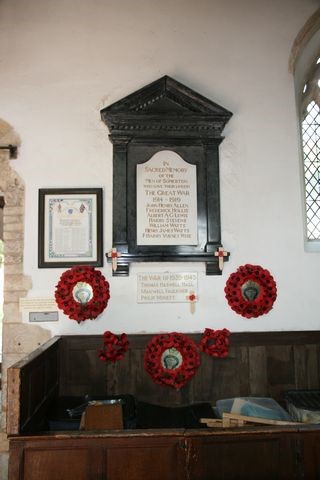
The memorial plaque in St James’s church records seven men from Somerton who gave their lives in the Great War: John Henry Allen, Frederick Hollis, Albert A G Lewis, Harry Stevens, William Watts, Henry James Watts, and F Harry Varney Wise. Individual research files were compiled for each man as part of the Somerton Village History Project, and are preserved in the church archive. What follows draws on that research.
Each man below has links to his war graves record where we could find it, to the cemetery or memorial where he is buried or named, and to the Bicester Local History Society roll of honour. John Henry Allen died at home after being discharged, and we have not found a war graves record for him.
John Henry Allen was born in Chesterton in 1896 and came to Somerton as a child, his family living in the Allotment Cottages where he and his father worked as farm labourers. He joined the 3rd Queen’s Own Oxfordshire Hussars in June 1915 and went to France that December. He came home sick the following spring, admitted to the Royal Hospital Chelsea with tuberculosis aggravated by his service, and was discharged in July 1916 as “no longer physically fit for war service.” He died on 18th December 1916, aged twenty. He was buried at Somerton five days later, and his burial is recorded in the registers of this church.
Records: Bicester Local History Society roll of honour
Frederick Hollis came from Ardley, born in 1890, the son of a shepherd. By 1911 the family had moved to Troy Field Barn, Somerton, where his father John and brothers Henry, Fred, George and Herbert all worked on the farm. Fred enlisted with the Oxon & Bucks Light Infantry and was serving in France by May 1915. He was subsequently transferred to the Middlesex Regiment. There are no surviving service records, but the Somerton parish register records him returning home as a “discharged soldier” aged 28, marrying Edith Maud Jarvis of Fritwell on 30th March 1918 - presumably discharged through wound or illness. He died on 22nd November 1918, aged twenty-nine, just eleven days after the Armistice. He is buried at Fewcott, and his name appears on the Ardley with Fewcott War Memorial as well as at Somerton.
Records: CWGC record · Fewcott churchyard (CWGC) · Bicester LHS roll of honour
Harry Thomas Stevens was born in Glympton in 1885, one of seven children. He moved to Somerton before the war, working as an ironstone labourer, and enlisted at Astrop, joining the 2nd Battalion Oxon and Bucks Light Infantry. He was killed in action on 26th September 1917, aged thirty-four. He is buried in Cambrin Military Cemetery near Béthune, just 800 metres from the front line.
Records: CWGC record · Cambrin Military Cemetery (CWGC) · Bicester LHS roll of honour
William Watts was born in Fritwell in 1890, the son of George and Mary Watts - farm labourers who had moved the family to Somerton by 1911. By then William was already a soldier, serving as a private in the Oxon & Bucks Light Infantry. He was killed at the Battle of Loos on 25th September 1915, aged twenty-five, and is remembered on the Loos Memorial. His brother Henry James (Harry) Watts was born in 1893 and was still at home in Somerton in 1911, working as a plough boy. He served in France with the Oxon & Bucks before transfer to the 8th Battalion Machine Gun Corps. He died on 27th May 1918 during the great German offensive on the Aisne, aged twenty-five, and is remembered on the Soissons Memorial. Two brothers from one family; both lost within three years.
Records: Loos Memorial (CWGC), William · Bicester LHS roll of honour, William · Soissons Memorial (CWGC), Henry · Bicester LHS roll of honour, Henry
Francis Harry Varney Wise was born in Bloxham in 1895, but Somerton was his family’s home: his grandfather Joseph Nash was a carpenter and wheelwright of Church Street, and Francis spent much of his childhood in the village. He enlisted on 1st September 1914, was drafted to Dunkirk, and eventually commissioned into the Royal Flying Corps - a long journey that took him through the Royal Naval Volunteer Reserve and several reserve battalions. He was awarded the Mons Star. On 13th January 1918 he took off from Hendon in a DH9 bomber en route to Martlesham Heath. At about 200 feet the aircraft suddenly banked and fell, killing both him and his observer, 2nd Lieutenant Albert Payne. He was twenty-two years old. He is remembered on the memorials at Somerton, Wroxton and Teddington. His brother Arthur Sidney was killed later that same year on the first day of the Battle of St Quentin.
Records: Teddington Cemetery (CWGC) · Bicester LHS roll of honour
Albert A G Lewis is also named on the Somerton memorial plaque, though his individual research file has not been located among the Somerton Village History Project records held at the church. The war graves records fill some of the gap. He was Private Albert Andrew George Lewis, service number 48338, of the 10th Battalion, Royal Fusiliers, and had earlier served with the 27th Battalion. He was the son of Joseph and Mary Ann Lewis of Somerton. He was killed in action on 9 April 1917, the first day of the Battle of Arras, aged 22, and has no known grave. He is commemorated on the Arras Memorial. The research continues. (Sources: Bicester Local History Society Roll of Honour, drawing on Commonwealth War Graves Commission records.)
Records: Arras Memorial (CWGC) · Bicester LHS roll of honour
These were not strangers to the village. Their surnames - Hollis, Watts, Stevens, Allen - run through the 1919 sale particulars, the school records, the census returns. They were the sons of farm labourers and shepherds, plough boys and carters, men who had lived and worked in Somerton’s fields. The plaque mounted on the wall of St James’s to the left of the church door is the village’s permanent record that they existed and that they are not forgotten.
New Research, 2026
Added October 2026. Each item below has been checked against the source named with it. Where only a transcript or a later account has been seen, that is said.
Faces in the Oxford Journal Illustrated
During the war the Oxford Journal Illustrated ran pages of small portraits under the heading "Heroes of the War". Three Somerton men appear in them.
On 22 August 1917 (page 6) the paper printed a portrait of "Pte A G Lewis, Royal Fusiliers, Somerton". This was four months after Albert Lewis was killed at Arras, and is almost certainly him, though the photograph itself has not yet been seen.
Gunner F. J. Baldwin of Somerton was pictured on 14 February 1917 (page 6), and Private P. T. Baldwin of the Machine Gun Corps, also of Somerton, on 12 December 1917 (page 6). Neither name is on the memorial plaque. Whether they were brothers, and what became of them, is still to be found out.
Sources: Oxfordshire History Centre, Oxford Journal Illustrated photograph index 1912-1928. The original newspaper pages are held at the Oxfordshire History Centre.
Two Somerton men join the militia, 1854
Long before the Great War, Somerton men were answering the call. On 25 April 1854, just as Britain went to war with Russia in the Crimea, the vicar of Deddington, the Rev. Cotton Risley, wrote in his diary: "Captain Cumming came from Oxford and I swore in 3 Recruits, two from Somerton and one from this place, for the Oxfordshire Militia." He did not record their names. If the militia attestation papers survive, they may tell us who the two Somerton men were.
Source: diary of the Rev. Cotton Risley, quoted in "Deddington 150 Years Ago", Deddington News, April 2004, Deddington History.
The Second World War
The war memorial plaque records the men of the Great War. From the Second World War, the war graves records add one Somerton name. Corporal Phillip Lancelot Minett of the Royal Air Force, service number 612929, son of William Lancelot and Dorothy Haynes Minett of Somerton, died on 10 August 1944, aged 28, and is buried in St James's churchyard, the only war grave there. We do not yet know how he died, or whether there were other Somerton men who did not come home. If you know more, please tell us using the form below.
Records: CWGC record · The Churchyard