Throughout the twelfth century the lordship of Somerton stayed in the Arsic family. They were wealthy local landholders and may have been responsible for the major building work on the church, where the lower part of the nave probably dates from the twelfth century and possibly some of the north aisle as well.
The Arsic family came to Somerton as part of the broader redistribution of Norman landholding after the Conquest. Manser Arsic had received the barony of Cogges, near modern Witney, and Somerton formed part of that holding. The family were substantial local landholders across Oxfordshire, not merely at Somerton. Throughout the twelfth century the lordship stayed in the Arsic line, and they may well have been responsible for the most significant building work on the church during that period: the lower part of the nave probably dates from the twelfth century, and possibly some of the north aisle as well. The round piers to the arches of the north aisle are transitional between Norman and Early English style - an architectural detail that places the work confidently in the late twelfth century. If so, these stones are the most tangible legacy the Arsics left in Somerton. The family’s name largely disappears from the village record after 1230, when Robert Arsic died without male heirs and the barony divided between his two daughters - an event that would shape Somerton’s history for the next three hundred years. In the church, however, something of their century remains: in the curve of those round piers, and in the proportions of the nave they helped to build.
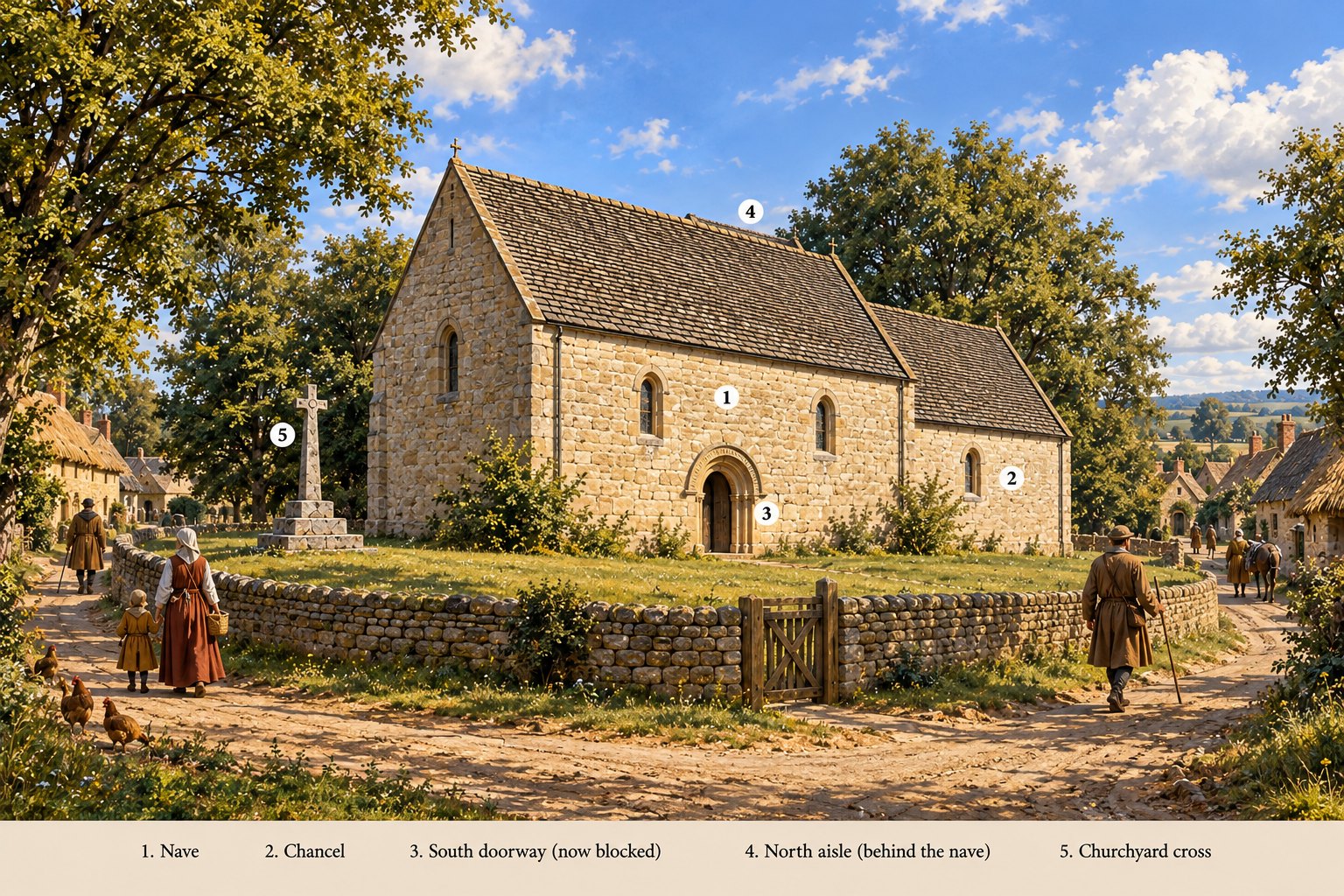
- Somerton Village History Project archive
New Research, 2026
Added October 2026. Each item below has been checked against the source named with it.
Land seized by King John, 1215 and 1216
In the civil war that followed Magna Carta, King John's letters record land being taken from a number of families and handed to others. Somerton appears twice. In the week of 22 to 28 November 1215 the king's close rolls record land at Somerton, Oxfordshire, confiscated from the mother of Robert Arsic and given to Eustace de Leon. In the week of 10 to 16 January 1216 they record seizures from Robert Arsic and his mother at Somerton and at Cogges, Oxfordshire, this time in favour of Samson de Gaugy.
We do not know Robert Arsic's mother's name, how much land was taken, whether the two orders were about the same land, or whether the Arsics got it back. Nothing suggests that Somerton itself was attacked. The dates are the weeks covered by Professor Vincent's articles, not the dates of the individual letters.
Sources: Nicholas Vincent, Magna Carta Project, "John and the siege of Rochester: week seven", note 10, and "John seizes Berwick", note 4, citing Rotuli Litterarum Clausarum, vol. I, pp. 238 and 245b. We have read Professor Vincent's notes, not the printed rolls.