In 1512, shortly after his arrival in Somerton, William Fermor had attempted to enclose some of the open fields, but this was checked. While the Fermors still lived at Somerton there were no further efforts to enclose the fields. But in 1765, another William Fermor gained an Act of Parliament to enclose the open fields - a fairly simple matter, for except for the glebe land, he owned the whole parish.
Somerton was a small but comparatively prosperous village for much of its history. In the 1780s, the quiet life of Somerton must have been greatly affected by the construction of the Oxford Canal along the Cherwell Valley. The canal between Banbury and Tackley was completed in 1787. It runs along the Cherwell valley and at Somerton passes between the river and the village - threading through the landscape between the water meadows and the foot of the limestone escarpment on which the village stands. Somerton Deep Lock, Lock No. 34, was built just under a mile north of the village. With a rise of approximately twelve feet, it is one of the deepest “as-built” locks in England - sharing that distinction with Etruria Top Lock on the Trent and Mersey Canal. The deep single-gate design was used throughout the southern section of the Oxford Canal as a cost-saving measure when funds ran short during construction; Somerton’s lock is among the most notable results of that economy. For some years the canal was the main artery between London and the Midlands, until the Grand Union Canal was built. Even more traffic was taken from the canal by the construction of the railway in Victorian times - a village which had hitherto been relatively isolated even had its own railway station.
Somerton Wharf, around 1840
Nobody painted Somerton's wharf in its working days, so this is an artist's impression, made in 2026 with an AI image tool from what the records tell us. It is set around 1840, after the canal opened and before the railway came. Some parts are still there today, some come from old documents, and some are simply a reasonable guess. The key says which is which.
Still there today: you can see it in Somerton now. From the records: described in old documents, but how it looked is not recorded. Imagined: added to make a believable picture, with no evidence either way.
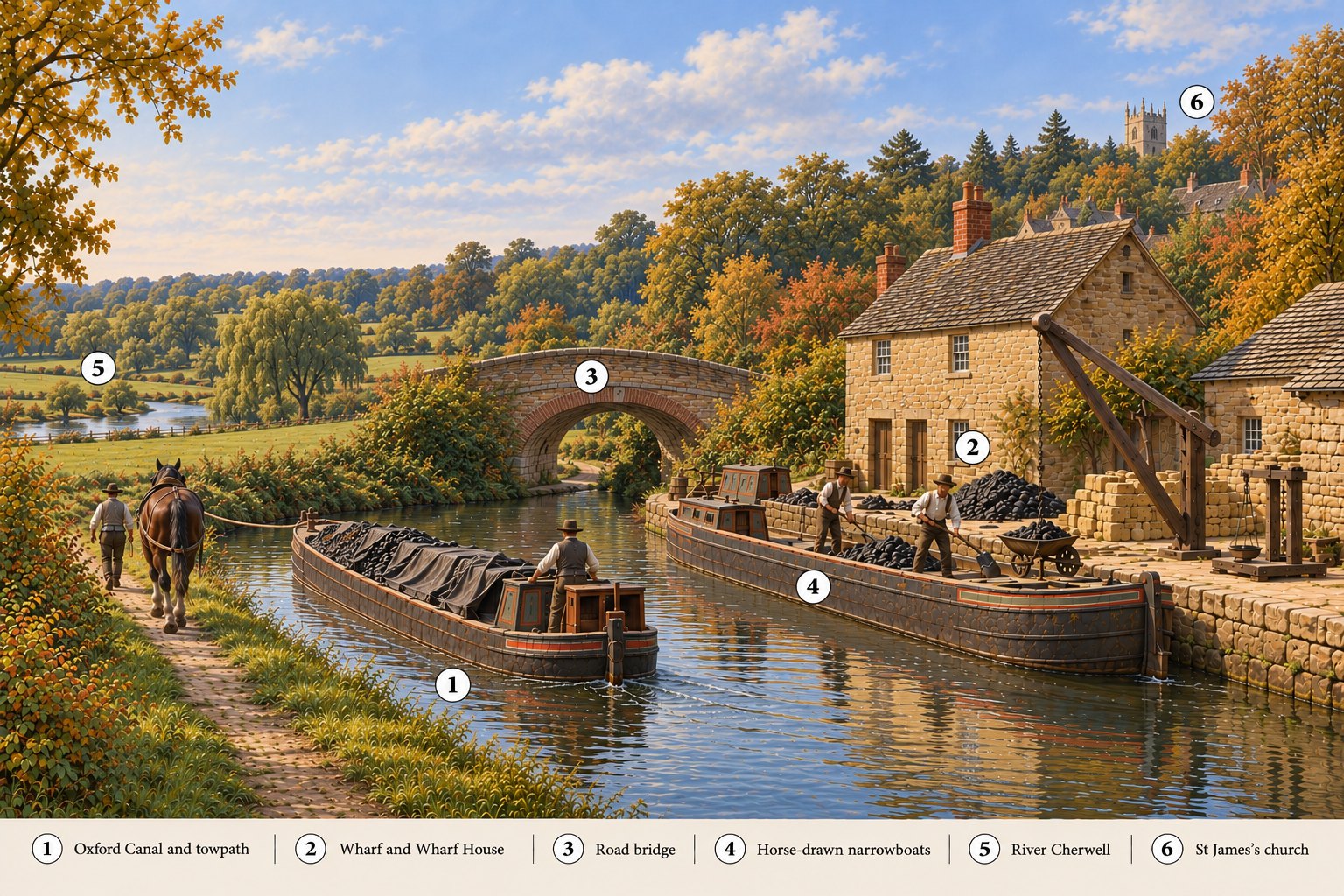
- Oxford Canal and towpath (Still there today). Open past Somerton from 1787. In 1840 every boat was pulled by a horse walking the towpath.
- Wharf and Wharf House (From the records). When the Somerton estate was sold in 1919, the Railway Inn lot included "the Somerton Wharf, on the Oxford Canal, and Wharf House", opposite the station. We have not yet found an earlier record, so its layout, the crane and the scales are Imagined.
- Road bridge (Still there today). The lane to the village still crosses the canal here. Its appearance in the picture is Imagined.
- Horse-drawn narrowboats (Imagined). Coal from the Midlands was the canal's main cargo heading south, so coal is what the boats are carrying. The people and boats are invented.
- River Cherwell (Still there today). The canal runs between the river and the village, with the water meadows in between.
- St James's church (Still there today). The tower is shown as it stands now, up the hill from the canal.
Not shown: the railway. The line opened in 1850 and the station in 1854, and with the embankment, the station and, later, the Railway Inn, this view changed for good.
Making a living: shops and trades
Farming was always Somerton's main living, but a village this size needed its own craftsmen and shopkeepers too. Somerton never had a market of its own: the Victoria County History found no record of one, and names Banbury as the nearest market town, though Bicester market was within reach as well.
Before 1800
The earliest trade on record is milling. In 1086 Domesday Book valued Somerton's mill at 20 shillings a year and 400 eels. By the fifteenth century there were two mills, one of them probably a fulling mill for finishing woollen cloth. In the sixteenth century two Somerton bakers and a butcher found their way into the records for cheating their customers. By the eighteenth century the village had a shop and a bakehouse, a butcher, a shoemaker, a blacksmith and a carpenter. A victualler was licensed in 1735, and one eighteenth-century rector complained of "too much tippling at the ale-house on Sunday".
From the newspapers, 1804 to 1836
A few earlier glimpses of Somerton's tradesmen turn up in Jackson's Oxford Journal. In December 1804 Mr Thomas Hore of Somerton advertised for a black yearling colt, a cart horse, with two white legs nearly up to the hocks and a blaze on its face. It had strayed, or been stolen, from Clifton Field in late November. Anyone who brought it back would be rewarded, and anyone who caught a thief would get five pounds once he was convicted. We do not yet know whether Thomas was related to Hannah Hore and W. Hore in the 1852 directory below.
In April 1814 William Collingridge of Somerton, shopkeeper, had to make over his estate and belongings for the benefit of his creditors. The deed was left for them to sign at the office of Churchill, Field and Weston, the Deddington solicitors. He is the earliest Somerton shopkeeper we know by name, and clearly he had fallen on hard times. Whether he was family to John Collinridge, the victualler of 1852, we cannot yet say.
In June 1836 the paper reported that Mr J. Bonner, butcher, of Somerton, had married Mrs Hannah Petty at Somerton. She was the widow of Thomas Petty, landlord of the Plough Inn at Deddington. Joseph Bonner is Somerton's butcher in the 1852 directory and may well be the same man, but the paper gives only his initial.
Sources: Jackson's Oxford Journal, 15 December 1804, p.3; 30 April 1814, p.3; 25 June 1836, p.3. Seen in the transcriptions published by Deddington History: 1800 to 1804, 1810 to 1814, 1830 to 1837. The original newspaper pages have not been seen.
The trade directories, 1852 to 1911
From the mid nineteenth century, county directories listed the tradespeople in every village. These are Somerton's entries in three of them. Farmers are left out of the table: in 1852 they were Isaac Berridge (also a surveyor and estate agent), William Godwin of Troy Farm, John Godwin, James Smith and Samuel Smith.
| Trade | 1852 | 1895 | 1911 |
|---|---|---|---|
| Post office | None: letters came through Deddington | James Baldwin, baker and post office | James Baldwin, shopkeeper and sub-postmaster |
| Baker and shop | Hannah Hore, baker and shopkeeper | James Baldwin, baker; Emanuel Moore, shopkeeper | James Baldwin, shopkeeper |
| Butcher | Joseph Bonner | Thomas Moore | |
| Pub | John Collinridge, victualler, farmer and brewer, Railway Tavern | Frederick Walton, Railway Tavern | Mrs Mary Ann Walton, Railway Tavern |
| Mill | W. Hore, miller and farmer; Elizabeth Wood Godwin, miller | Arthur B. Field, miller (water and steam) and oatmeal manufacturer | R. W. Rench, miller (water and steam), Somerton Mill |
| Blacksmith | Samuel Plumbe | ||
| Carpenter and wheelwright | Reuben Johnson, carpenter; Daniel Weaver, wheelwright | Joseph Nash, carpenter | |
| Shoemaker | Thomas Adams | ||
| Tailor | Thomas Taylor | Thomas Taylor | |
| Gardener | Thomas Pullen | Henry Pullen, market gardener | |
| Carrier | Harry Mitchell, to Banbury on Thursdays | ||
| Village club | Somerton Benefit Society | Somerton Benefit Society |
A blank does not always mean the trade had gone, only that the directory did not list anyone. In 1911 the station master was William Webb, the schoolmaster James Rance, and two more carriers, from Caulcott and from Heyford, passed through on their way to Banbury on Mondays and Thursdays.
Where they were
The directories do not give addresses, but the 1919 sale catalogue and villagers' memories fill in some of the map. The post office, shop and bakehouse stood opposite the church: the Baldwin family kept it from at least 1895 to 1919. Thomas Moore's butcher's shop was on the Fritwell Road. The pub was at the bottom of Water Street, opposite the station. There was a carpenter's shop by the cottages at the Paddocks, and Joseph Nash, carpenter and wheelwright, worked in Church Street. Later, the doctors' surgery was in the Old Post House in Church Street, and coal was sold from where the Church Street cottages now stand.
The 1910 valuation survey, which recorded every property in England for a new land tax, adds more. In Somerton nearly everything still belonged to the Earl of Jersey. James Baldwin had the house and buildings at the Post Office. Mary Ann Walton had the Railway Tavern together with its buildings and the wharf. Richard Wells Rench had the house and mill at Somerton Mill, with Louis Butler in a cottage there. John Woodward lived in the cottage at the canal lock and Joseph Lewis in the cottage at the railway crossing. The estate kept a timber yard at the Paddock, which explains the carpenter's shop sold there in 1919, and the carrier, Harry Mitchell, lived in one of the Paddock cottages. Thomas Moore, the butcher, had a house and buildings at the Hollow Way, and Joseph Nash a house and land in Church Street. The village also had a reading room and a bowling green.
No forge appears in 1910, and no blacksmith in the 1911 directory, so the smithy had probably gone by then. According to family historians, the Plumbs were Somerton's blacksmiths for three generations through the nineteenth century, and Samuel Plumbe is the blacksmith in the 1852 directory, but we do not yet know where the forge stood. Out at Troy Farm, a range described in a recent heritage assessment as the "old bakery" survives, thought to date from the Godwin family's time there. If you know where the forge, the shoemaker or the tailor were, please tell us using the form below.
Somerton Mill
The mill is the one business that runs right through Somerton's history, from Domesday to the twentieth century. By the eighteenth century only one mill was left, owned by the Fermors, and in the nineteenth it employed a manager and five men. By 1895 it was running on steam as well as water and making oatmeal. When the estate was sold in 1919, Mill Farm came with 87 acres and a water mill on four floors, worked by windlass and chain.
Shops on wheels
Within living memory much of the shopping came to the door (there is more on this in Doing the Shopping in Somerton). Bread came from North Aston, and a van from Steeple Aston brought fruit from Charlie Preston. Groceries were ordered from the Co-op, first at Steeple Aston and later at Upper Heyford. A grocery van from Callows of Upper Heyford called several times a week, and so did the county library van. A man in a maroon van came round to charge batteries. In the village itself, Mrs Waddup and then Mr Wickson kept the shop, Mr Moore was the butcher, with milk sold at the back of his shop, Mr and Mrs Knight ran the dairy, and Mr Harris mended the farm workers' boots.
Local memory also says that a paper mill once stood on the site of the old wharf. It does not appear in the directories up to 1911. What we can now show is that by the early 1990s the wharf was used as a paper-recycling yard, collecting waste paper and baling it, rather than a mill making paper; see Lost Somerton. If you know who ran it, or anything earlier, we would love to hear from you.
Sources: Victoria County History, Oxfordshire vol. 6, Somerton; R. Gardner, History, Gazetteer and Directory of Oxfordshire (1852), p. 772; Kelly's Directory of Oxfordshire (1895), p. 272, and (1911), p. 319, all seen in the University of Leicester's Historical Directories; the 1919 Somerton estate sale catalogue; 1910 valuation survey, Somerton, Oxfordshire History Centre DV/X/73 (Heritage Search); Schooldays memories.
The speed of change increased through the twentieth century. Farming remained the main employment but fewer and fewer labourers were needed. The tied farm labourers' cottages were sold off or rented to RAF or US service personnel from the Upper Heyford base. Few families stayed in the village for more than one or two generations.
The Village Produce Association
During the Second World War, Somerton's Village Produce Association, set up in 1942, brought the village together to grow and share its own food, with a roadside stall opposite the Village Hall and, from 1943, an annual produce show. The full story, with photographs and the wartime film, is on the Village Produce Association page.
Meanwhile, the advowson or patronage of the church had passed to the Barnes family. William Barnes of Great Duryard in Devon bought the patronage of the parish of Somerton and in 1875 nominated his son George Edward Barnes as Rector. What followed was the longest single incumbency in the modern record of the village. Barnes served for forty-eight years - from 1875 until 1923 - and his mark on Somerton is visible everywhere you look in the church and in the life of the village. He was no absentee. He lived in considerable style in what is now the Old Rectory and was entirely committed to the parish. Under his stimulus the Barnes family were generous in their support for the church, leaving evidence of his enthusiasm for the Arts and Crafts and Pre-Raphaelite movements that were then at their height. He commissioned the magnificent carved choir stalls in the chancel, working with the architect Henry Wilson. To commemorate his father, who had appointed him, he commissioned the window at the east end of the north aisle - the Whall window - which remains one of the finest pieces of Arts and Crafts stained glass in Oxfordshire. He introduced most of the pews in the nave, and the magnificently carved pews in the chancel. Beyond the church, it was Barnes who negotiated the land and drove the establishment of the Village Hall - the Barnes Memorial Hall was built in 1924, the year after he died, as a direct tribute to his forty-six years of effort for the community. The last wedding he officiated was that of Owen Charles Hind to Nancy Brown in September 1922. John Webb, who researched the Barnes family in detail for the Somerton Village History Project, concluded simply that he was the kind of rector - engaged, generous, long-serving - that transforms a parish. The village was fortunate to have him for as long as it did.
- Somerton Village History Project archive
New Research, 2026
Added October 2026. Each item below has been checked against the source named with it.
A smockmaker and a lacemaker, 1851
The 1851 census shows how much making still went on in the village. Besides the farmers and labourers there were a stonemason, a thatcher, two dressmakers, a tailor, a lacemaker, a smockmaker, a wheelwright, an instrument-maker and a contractor, probably working on the railway.
The smockmaker is a nice one. Smock frocks were what farm men wore over their clothes, and in a village of shepherds and carters somebody had to make them. We do not yet know her name, or his. Nor do we know what the instrument-maker made.
Sources: Victoria County History of Oxfordshire, vol. 6 (1959), Somerton, summarising the 1851 census. The census pages themselves have not been seen.