The Coming of the Railway and its impact on the village of Somerton
The Railway came to Somerton in the 1850s. The impact on the village was massive: through the employment it provided, the opportunities for travel, and the local interest resulting from accidents and incidents – including the passage of royal trains. The railway’s finest hours came during the two World Wars, but the volume of traffic undermined its infrastructure, and in 1964 Somerton Station finally closed, a victim of Dr Beeching’s cuts.
Construction
Royal Assent was granted to the Great Western Railway on 4th August 1845 to extend their railway service from Oxford to Rugby, however in 1849 the planned route was changed to go to Birmingham and was surveyed by Brunel. Landowners were not always willing to sell their land, holding out for higher compensation. Lord Jersey had to be promised a station at Somerton in exchange for his agreement. Parishes along the route were compensated with a contribution to their rates – in Somerton’s case a rate contribution of £1 in 1848.
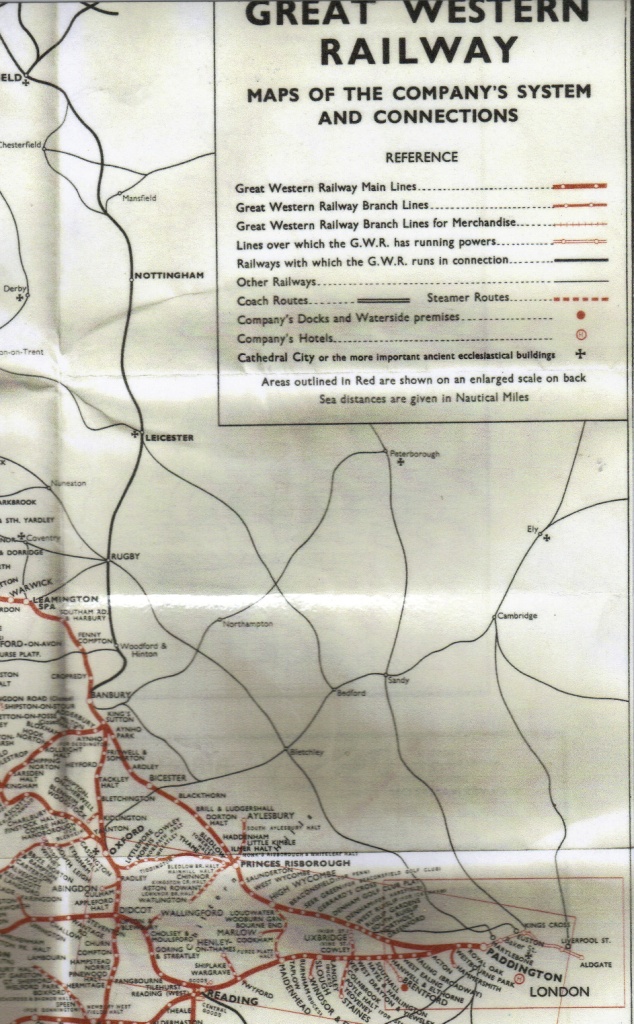
By Autumn 1849 the total cost of the Oxford to Banbury section of the line reached £760,000, the earthworks to build the embankments (necessary due to the flooding) and cuttings alone costing £85,000. Flooding in the valley became more frequent as a result of the building of the railway.
The railway navvies would have had a big effect on the quiet village community. The regulars earned 4s a day and local farm labourers could earn 2s 6d a day for working on the line, double their normal wages. However the work was hard, handling heavy loads of earth and stones and there were frequent accidents. Laying of the track began in the spring of 1850 and the 24 mile long rural branch line was opened on Monday 2nd September 1850 with three prefabricated timber built stations at Woodstock (Bletchingdon, Heyford and Aynho (later known as “Aynho for Deddington”).
The First 50 years
By the autumn 1852 the Cherwell Valley line had become part of the important new GWR line from London to Birmingham with frequent traffic of express trains, local services and goods trains.
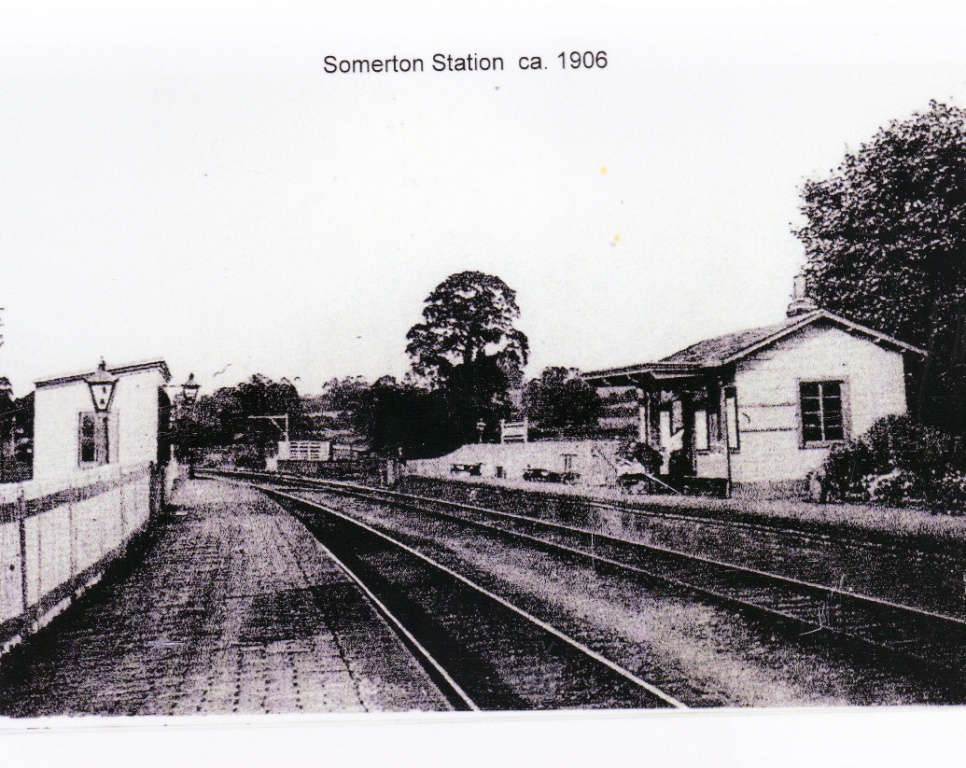
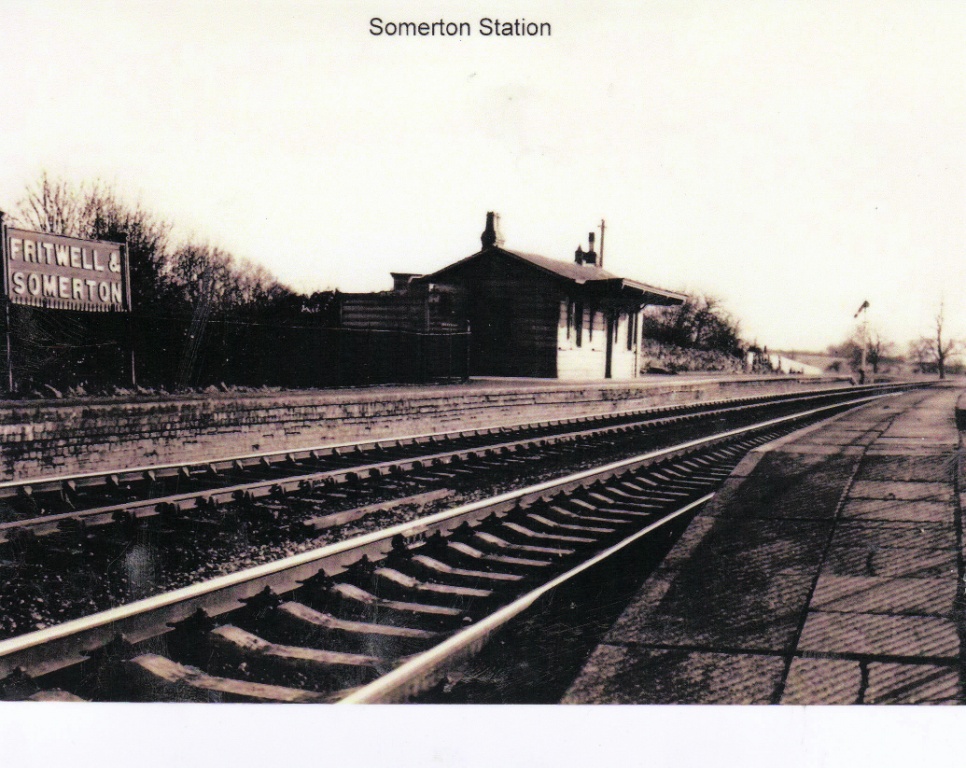
Somerton Station was opened in September 1854, a simple wooden structure as it always remained. There was only room for one siding with a cattle dock and space for the local coal merchant to unload his wagons. (When a station was opened at Somerton in Somerset in July 1906 it was renamed “Somerton Oxon”, and later on 1st October 1907 was again renamed “Fritwell & Somerton”.
Inevitably there were accidents. In November 1852 a delayed express train speeding towards Heyford at 60 mph collided with a local train which was reversing to pick up a truck and was partially blocking the route. Passengers were bruised and shaken but the driver jumping on to the track fell against a point lever severely injuring his head and leg. Mr Edward Wilson, a surgeon from Steeple Aston, was summoned but it was too late to save the driver’s life. In July 1855 a carter carrying hay from Fritwell meadow with a team of 4 horses waited for the down train to pass and then began to cross and was hit by the 16.50 up train from Banbury to Oxford, knocking the wagon to pieces and killing the shaft-horse. Fortunately the other three horses and the carter escaped injury and no passengers were hurt.
These accidents would have been much talked about locally and indeed the coming of the railway brought much of interest to the village. From the 1850’s to the 1870’s the royal train carrying Queen Victoria would pass through the valley three or four times a year, driven slowly so that the locals could glimpse the royal party and wave and cheer. The GWR would place its police with porters and track maintenance men all along the route and a pilot engine would be driven down 15 minutes ahead of the royal train to ensure the way was clear. All goods trains in the opposite direction were stopped until the train had passed. The carriage was very luxurious and had been specially built by the GWR – it was often getting dark when it passed through Somerton and the carriages would be lit up.
The railway gave villagers the opportunity to visit Banbury, Woodstock and Oxford which would not have been possible before without a long, slow journey by cart. Trains for third class passengers were slow and often took cattle, horses and other livestock. In 1865 there was only one stopping train each way between Oxford and Banbury fully open to third class passengers, 11.00 from Oxford and 15.50 from Banbury. Three further trains each way a day were aimed at second and first class travellers which were then the main source of income. Local workers used the railway for special reasons and it was a common sight to see a father put his daughter on a train to take up a post in domestic service. He would have pushed her box down to the station on a wooden wheelbarrow.
During the 1860’s special excursion trains began to be organised with cheaper excursion fares to places like Henley on Thames, Portsmouth, Margate and Weymouth. The return fare would be in the order of 5s 6d and these excursions were popular with those who could afford them.
Farm labourers would not have been able to afford to travel on a regular basis and the number of daily customers from Somerton would have been low. A special train was run for farm workers going to Banbury for the Hiring Fair to seek new jobs. George Dew, eldest son of John Dew who ran the family building firm and the post office in Steeple Aston, records in his diary journeying to London on 8th August 1862 to attend the International Exhibition. The excursion train departed from Heyford at 07.22 and returned at 23.40. [i]
In 1868 the broad gauge track laid originally was taken up and replaced by the narrow gauge used by the London & Birmingham Railway built by George & Robert Stephenson running via Aylesbury and Bicester. In 1872 some workers based at Somerton, Robert Golder and a father with 2 sons named Andrews from Wales, contracted Smallpox. The Andrews family died and their deaths were registered by George Dew on the steps of the Railway Tavern in Water Street. Golder recovered and was looked after in a house next door.
Photo of Railway Tavern to follow.
In the 1870’s and 1880’s a depression in agriculture caused many rural labourers to emigrate and a train carrying 60 agricultural workers from villages south and north of Banbury left Banbury for Liverpool to link with a boat taking them to America. During the Great Depression the railways continued to thrive and expand. The rural railways changed the social habits and outlook of villagers and third class travel grew rapidly and by 1890 96% of travellers were third class, most of these the children of parents who would rarely have travelled far from the village.
The railway in the 20th century – the two Wars and the General Strike
Scheduled rail travel peaked in 1912 but traffic was greatly increased for the war effort in 1914. Special trains running from Banbury to Oxford picked up men who were mobilized into the Oxford & Bucks Light Infantry. They were seen off with great enthusiasm but all too soon there were convoys of hospital trains making their way up the valley en route from Southampton to military hospitals in the Midlands. The men were carried in mail vans with large red crosses painted on them and converted to hospital wards with 16 beds in two tiers. Many of the trains carrying 8,000 casualties at a time would have passed through the Cherwell Valley – 2.5 million were transported in total.
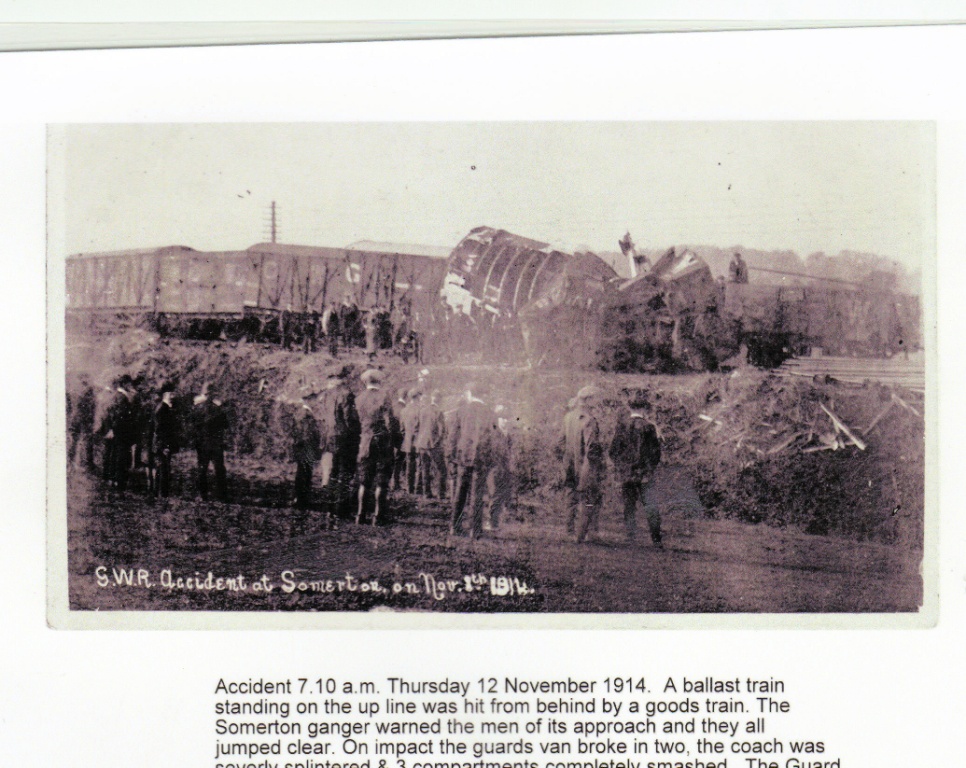
While people continued to travel on business and pleasure throughout the War, the additional military traffic greatly increased demands on the track, engines and rolling stock and there were unfortunately more accidents. At Somerton on 8th November 1918 at 07.10 a ballast train was run into by a goods train which had run through the signals and the guard’s van broken into two. The guard, Ernest Justice, was seriously wounded on his thigh and a yard ganger, John Boffin, was injured. They were taken on the engine to the Oxford Infirmary. Several wagons were derailed and both tracks were closed for the rest of the morning while breakdown gangs worked to repair the damage.
|
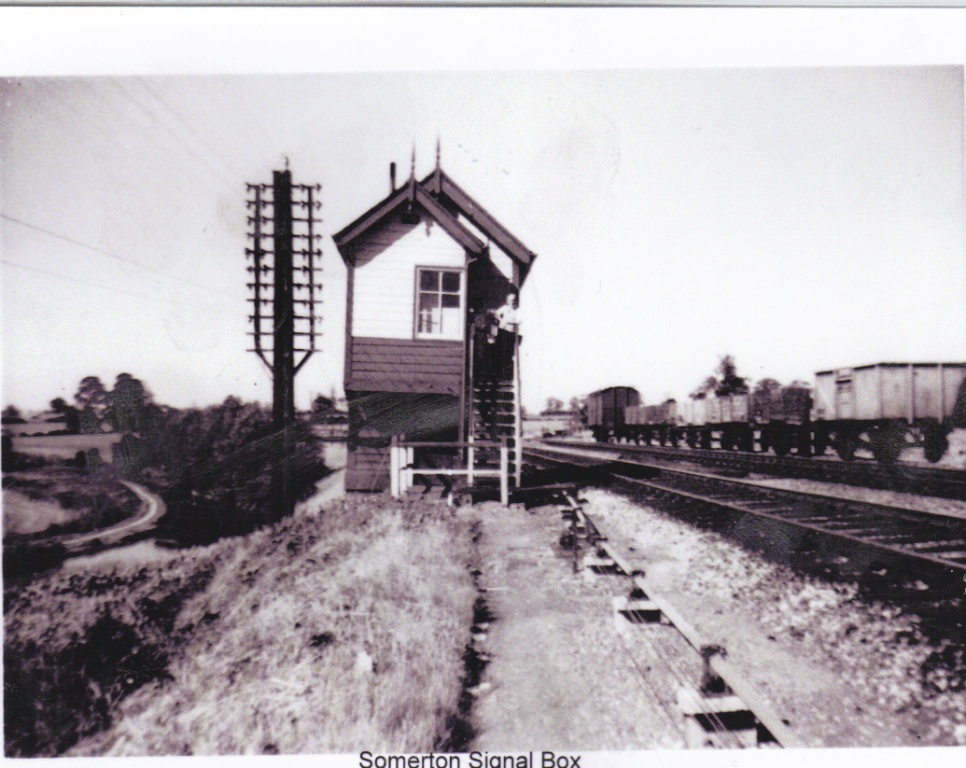
Voices ~ Albert Fox Following the Road and Rail Traffic Act of 1833 economies were made and Somerton had to share a station master with Heyford (Mr Ingram). Most of the supplies for the local shop were brought into the village by rail and taken up the hill by horse and wagon. The station was one of the few places that had a telephone. There were two porters who worked in shifts 6am – 2pm and 2pm – 10pm. I remember Ted Giles and Walter Mold from North Aston. The signal box was manned on a similar shift pattern with Ralph Hazell always on with Ted Giles and Harry Edwards with Walter Mold. There was a group of platelayers permanently employed in Somerton under their leader Ganger Powell (from Ardley), these included Ted Coombes, Bert Garrett and David Waddup, who lived to be 90 and guarded the smoke hole in the Ardley tunnel during the 1914-1918 War. 12 trains stopped each day at Somerton right up to the closure on 31st October 1964, the first train leaving at 6.05 am. The workman’s return fare to Morris Cowley Station(some 20 miles away) was 1s 0 ½d and later went up to 1s 2½ . Up to the outbreak of the 1939 war a railcar did one round trip Oxford-Banbury-Oxford calling at Somerton at 12.10 and 1.15. My season ticket fare to Banbury to attend school was£13s 9d a month or £32s 6d for 3 months. |
Eventually the Railway Executive Committee announced that resources were dangerously overstretched and that domestic services would be reduced to meet the demands of wartime traffic.
Between 1915 and 1917 twenty seven stations were closed by GWR but Somerton survived at this time. Many expresses were suspended. In 1918 the railway trade unions demanded a 10s pay rise but were only given 5s resulting in a 48 hour strike in Banbury. Within weeks the War was over but the railways never returned to normal. The GWR had borne the brunt of the war effort. 25,479 GWR men had joined the fighting forces of whom 2,524 lost their lives. The legacy of the War was a series of labour problems culminating in the General Strike in 15th May 1926. Volunteers replaced the striking railwaymen to maintain a skeleton service and provide trains for essentials such as the carrying of milk to London. By the third week of May the strike was virtually over but the full service to Banbury was not fully restored until July. The strike cost GWR over £4 million.
From 1933 GWR began building diesel “railcars” which were more economical to run than steam locomotives and these ran through the valley on the Banbury to Swindon service. Britain’s longest distance train service also passed through the valley – a daily service from Aberdeen to Penzance with through carriages, including sleeper cars, attached to other trains.
|
Voices~ Miss Moore I remember going to Queen’s Ice Skating Club in London which was cheap and easy to get to in those days, arriving back at Fritwell & Somerton station at 11.11 in the evening. The guard would hold the train for about a minute. |
|
Voices ~ Albert Fox The controlled level crossing near Somerton Mill was manned full time with the crossing keeper living in the cottage provided by the GWR, the last keepers being Mr & Mrs Golder. Other names remembered are Station Masters Jones and E. Giles, Mr Burham, Sam Calver, Glyn Parry, Fred Attwell and Bill Stevens (in addition to those mentioned above). “Sometime in the 1930’s an elderly gentleman living with the Golder family at the level crossing cottage, Joey Perks, was knocked down by the 12.55 stopping train to Banbury and I think died within minutes. The inquest was held in the “upper room” at the Railway Inn and my father was one of those on the Jury”. |
Railway employment still offered reasonable security with farm labourers in the area earning less than £1.50 a week and in the mid-1930’s railway workers were better off and their jobs much sought after, however, in 1939 the coming of the Second World War again brought about drastic changes. In September the evacuation of civilians from London began and thousands were found temporary homes in the Cherwell Valley towns and villages with train loads arriving : Banbury received 800 on Saturday 1st September, 1600 on the Sunday and another 800 on the Monday! With the broadcast on the Sunday declaring that Britain was at war with Germany there was an immediate increase in rail traffic of troop trains plus stores and ammunition trains. Trains were also used to “evacuate” meat and butter from London to cold stores in the countryside. The villagers of Somerton would have witnessed the effect of the start of war immediately. In 1940 trainloads of troops evacuated from Dunkirk were transported along the valley, many throwing messages out as they passed through the stations hoping that local telegraph staff would relay the news to their families to let them know that they were safe.
In the build up to D-Day the huge build- up of supplies for the landings resulted in tremendous traffic on the Cherwell Valley line with over 1200 freight and military trains passing through in just one week. By VE day the railways were worn out having been stretched to their limits and it was obvious that a massive investment programme would be necessary and the new Labour Government nationalised the railways with the Transport Act of 1947 with the British Transport Commission taking control on 1st January 1948.
For economic reasons between 1948 and 1959 2,944 miles of the country’s railways were closed with the Kings Sutton to Chipping Norton service closed in 1951, followed by the closure of the Woodstock branch line in 1954. The appointment of Dr Beeching in 1961 spelt the end of an era and in spite of many objections the Cherwell Valley Stations came under his axe with only Tackley, Heyford and Kings Sutton surviving. Fritwell & Somerton saw its last train call on Saturday 31st October 1964.
By 1972 the ex-LNWR line from Euston became the main route to the North West via Birmingham. At the end of it all there are still trains running through our valley but only at a fraction of past levels.
[i] Oxfordshire Country Life in the 1860’s : The early diaries of G.J. Dew ed. by P. Horn 1986
History of the Railways of Oxfordshire Bill Simpson Part 1 The North 1997
History of the Great Western Railway E.T. MacDermot