At the centre of Somerton stands St James the Apostle Church, a Grade I listed building that has long defined both the physical and cultural landscape of the village. It contains Norman stone, medieval carving, later additions, and personal histories spanning centuries. All of it remains — not replaced, but added to.
The church stands on a knoll to the south of one of the tracks leading down from the tableland to the east, towards the water meadows along the Cherwell. It is unusually large and imposing for what has never been a large village. It has architectural elements from every century between the eleventh and the sixteenth, and it contains remarkable monuments.
The Structure
In the churchyard stands a medieval preaching cross; the knoll may have been a site of worship in Saxon times. The first building on this site was erected shortly after the Norman Conquest. The blocked-up Norman door on the south side of the nave — with its round arch — may have been the original entrance to the church.
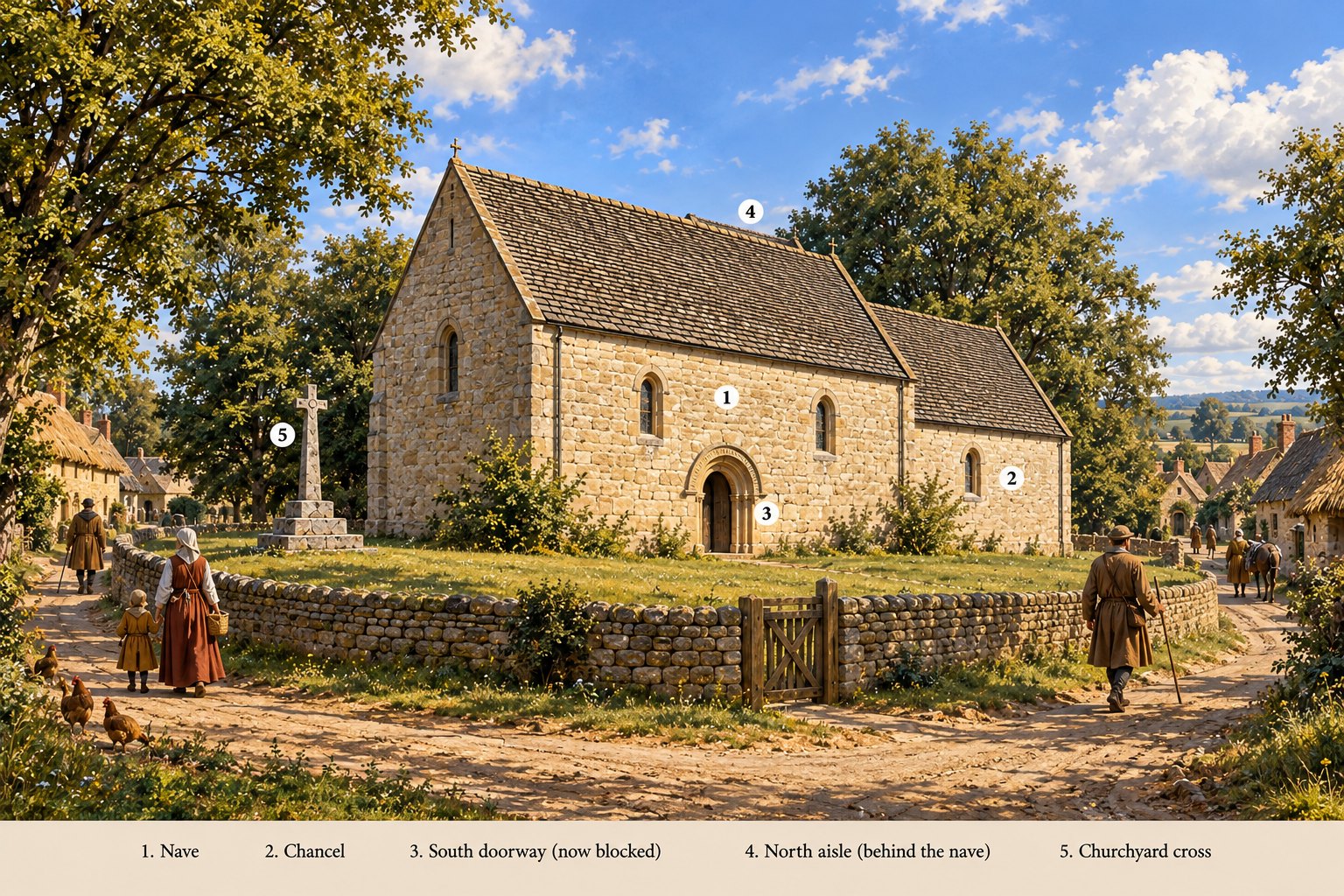
There was no tower yet, no south chapel and no large Gothic windows: all came later. The cottages, people and churchyard wall are imagined.
- Nave (Still there today). The outline of the nave and some lower stonework probably go back to the twelfth century.
- Chancel (Still there today, much altered). Restored in 1854.
- South doorway (Still there today). The round-arched Norman door, now blocked, may have been the original entrance.
- North aisle (Still there today). Hidden behind the nave in this view. Its round piers date from the late twelfth century.
- Churchyard cross (Still there today). A medieval cross; in reality it stands on the north side of the church, so it would be out of sight from here.
The church today
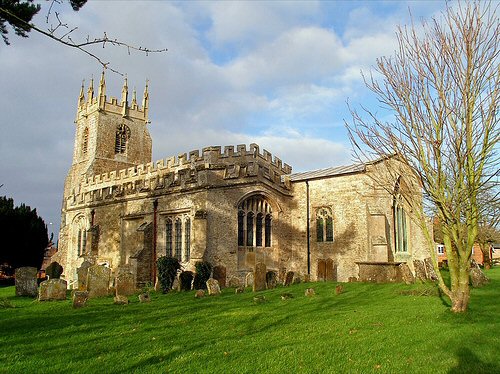
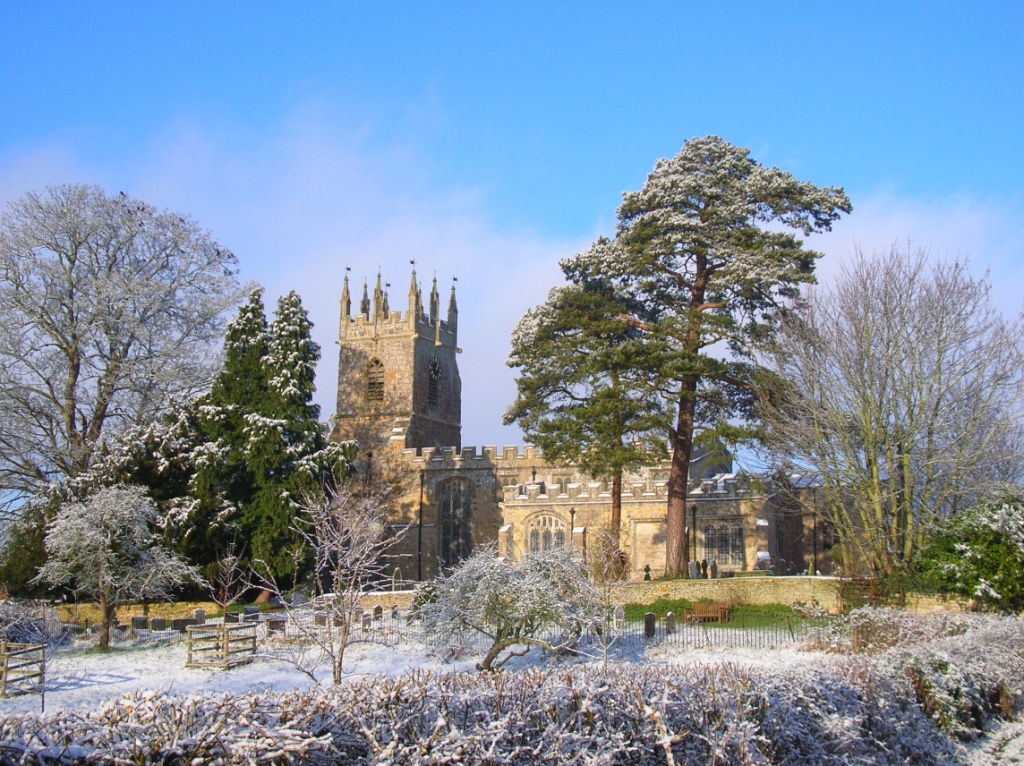
The outline of the nave and some of the lower stonework probably go back to the twelfth century. The North Aisle was added around 1200, and the Chancel about a hundred years later. The fourteenth century saw the building of the Tower and the Porch. Here ironstone was used rather than the local limestone — Somerton is close to the geological border between limestone and ironstone country, and a very white limestone was used to good effect for the Crucifixion depicted on the north side of the Tower. The bell tower is also probably fourteenth century.
The fifteenth century saw further works not to extend the church but to make it more imposing. The roof of the nave was raised and the clerestory added; crenellated battlements and pinnacles were added to the nave, side aisles and tower to give the whole church its present “visually assertive” appearance — and the east end of the south aisle a slightly rakish aspect. The gargoyles were added at this time too. The louvers in the tower were probably added in the sixteenth or seventeenth century, when the single chiming bell was introduced.
A major refurbishment took place at the end of the nineteenth century under Henry Wilson (1864–1934), who had taken over the architectural practice of JD Sedding. Wilson was noted not only as an architect but also as a designer, and his work at Somerton represents some of the finest Arts and Crafts craftsmanship in Oxfordshire. He designed the magnificent choir stalls and the decorative glazing in the chancel.
The Chancel and Reredos
The oldest and perhaps the single most important carving in the church is the remarkable stone Reredos behind the altar. This probably dates from about 1400 and depicts the Last Supper in splendidly lively style. All the figures are caught in mid-gesture — one disciple is refusing another drink — except for John who is lying in the lap of Christ. It has been described as “medieval sculpture at its most engaging and accessible: humane, animated and brimful of charm.” It is made of Brize Norton stone and is similar to a reredos at Bampton. It was taken down and hidden from the Puritans in the 17th century, only returned to its position in 1822. The damaged section immediately in front of Christ may originally have held a carving of Judas Iscariot.
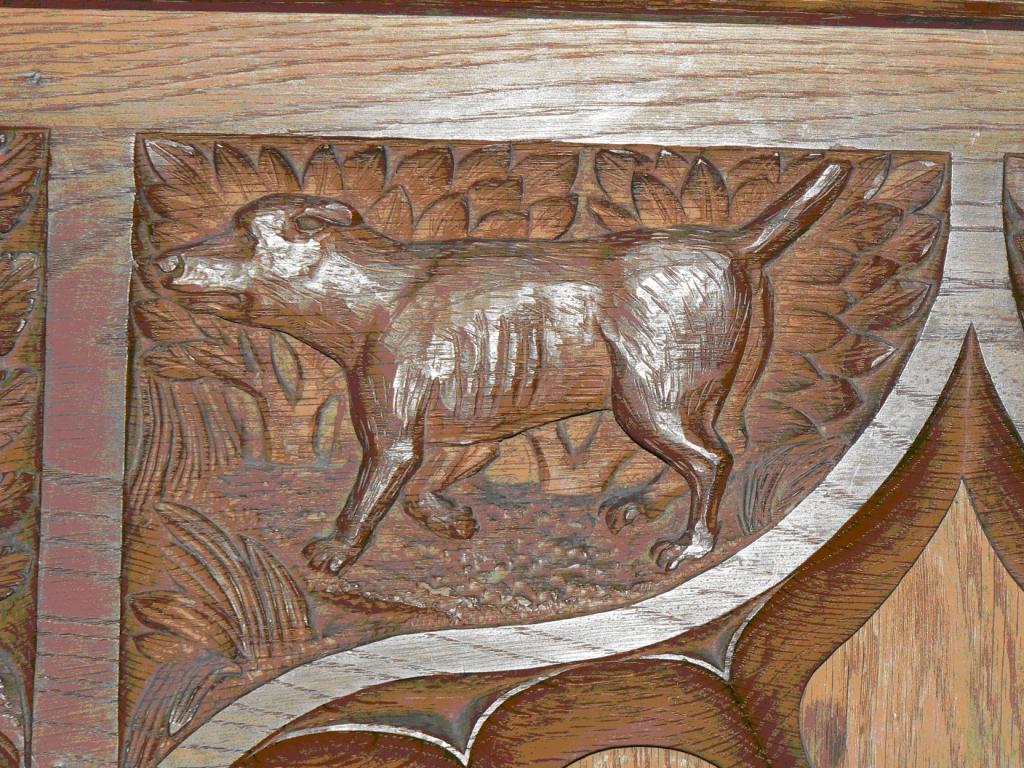
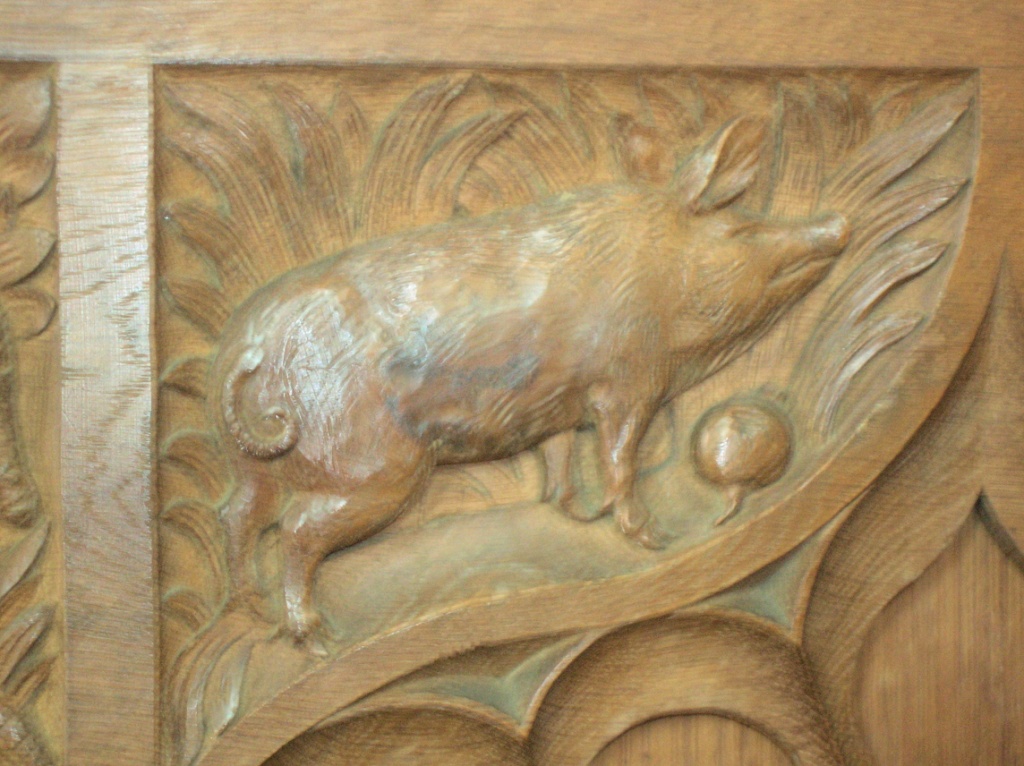
The three-seat sedilia on the south wall of the chancel dates from the fourteenth century. The choir stalls incorporate two medieval bench ends but date from the late nineteenth or early twentieth century, designed by Henry Wilson. They are fine examples of the Arts and Crafts style, the carvings depicting an enchanting menagerie of animals with seated figures supporting the arm-rests.
The rood screen separating the chancel from the nave is a particularly fine example of late fifteenth century work. The upper parts are substantially original and the tracery heads are of great finesse. The double middle rail is a rarity — others are found at Cherry Hinton in Cambridgeshire and Llanegryn in North Wales. The screen features a series of wheels each containing four mouchettes, motifs typical of the earlier Decorated Gothic style, while the panel tracery above is typical of the later Perpendicular style — the two idioms sitting in deliberate combination. The screen would originally have been vaulted, with vaulting ribs springing from the tops of the shafts between each tracery head; the vaulting would have formed the underside of the now missing rood-loft above. On the lower left of the screen is an armorial panel dated 1632 with the arms of William Juxon, Rector of Somerton, who later attended King Charles I on the scaffold.
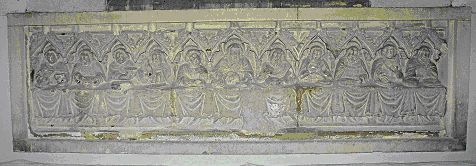
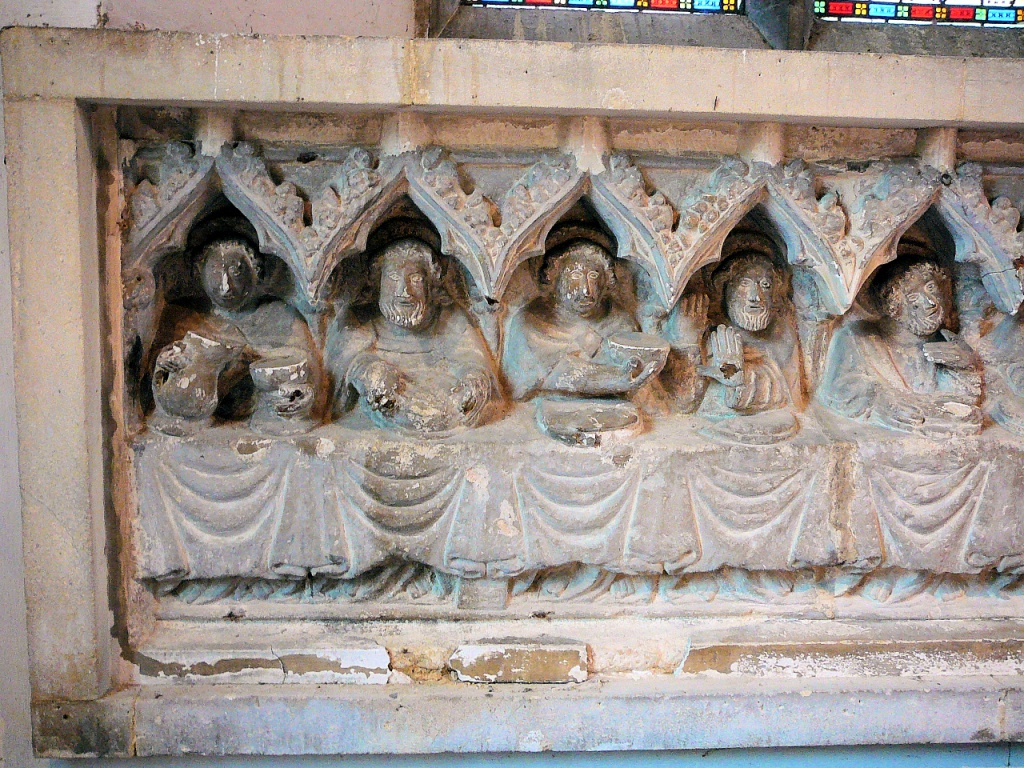
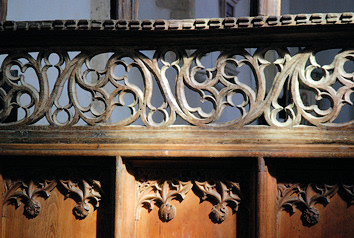
(reredos – left side. One of the apostles has evidently had enough to drink already!)
The Fermor Chapel
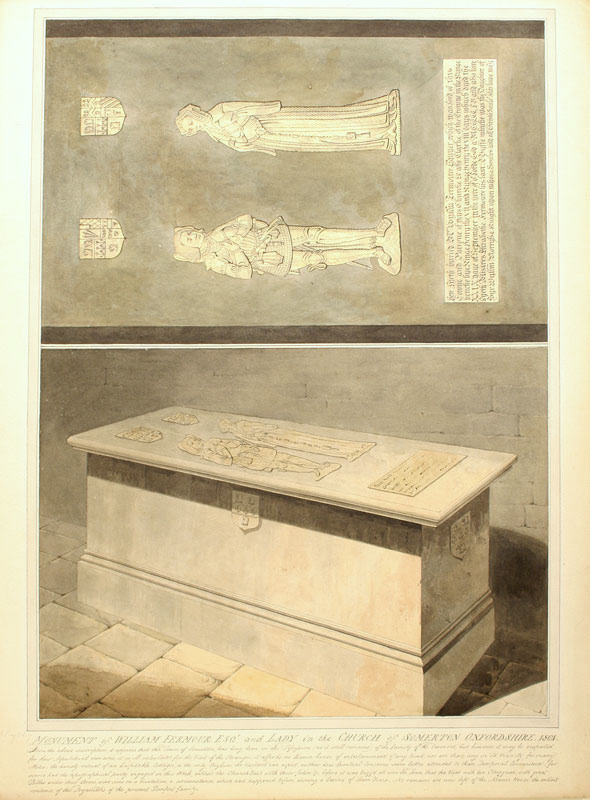
The influence of the Fermor family is nowhere more visible than inside the church. The Fermor Chapel has a separate entrance to the south, and it is interesting to speculate that William Fermor may have had it built so that he could quietly continue the old rites in a separate part of the church. Writing in 1801, Thomas Trotter — archival watercolourist to the Royal Society of Antiquaries and a pupil of William Blake — recorded his concern about the state of the monuments: “The Dormitory of the Fermors in this church contains many curious Monuments, which we cannot but lament is hastening to decay… the all destroying hand of time is committing daily depredation which cleanliness and a few occasional repairs might have prevented.” That Trotter’s alarm spurred later action is a small but genuine debt the monuments owe to his visit.
The founder of the dynasty, William Fermor, and his wife Elizabeth Norrys have a tomb chest next to the screen to the chancel, with fine brasses — palimpsests, re-used with memorials to someone else on the reverse. His tomb was described as "a great raised monument of gray marble — thereon ye picture of a man and a woman in brass."
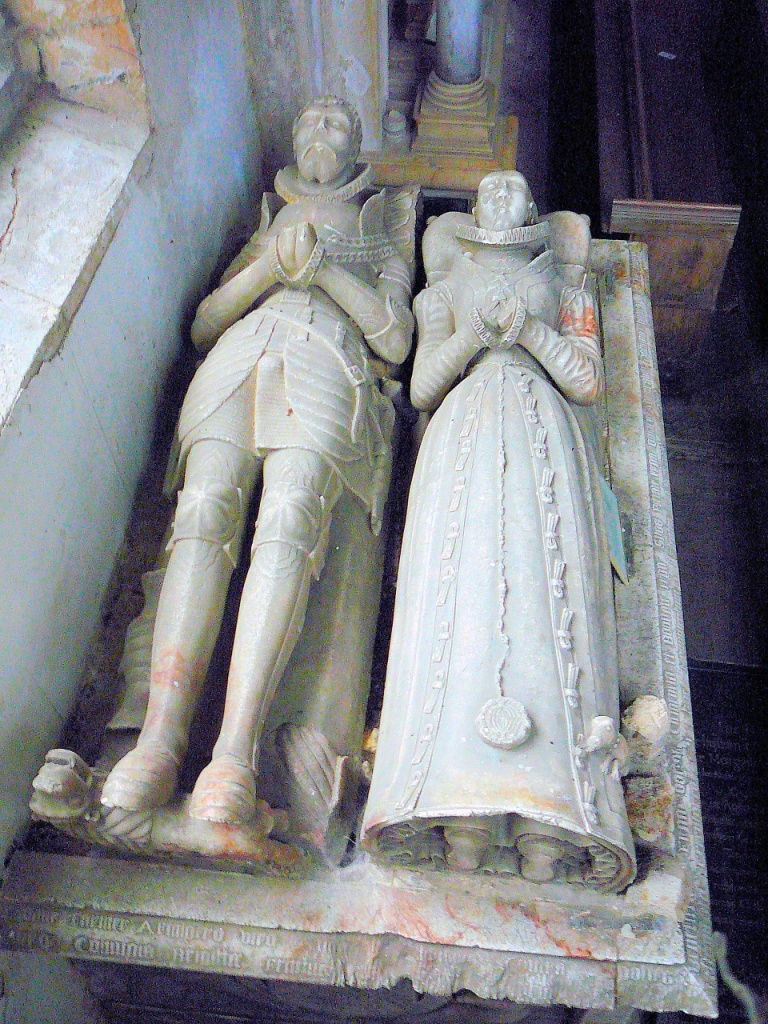
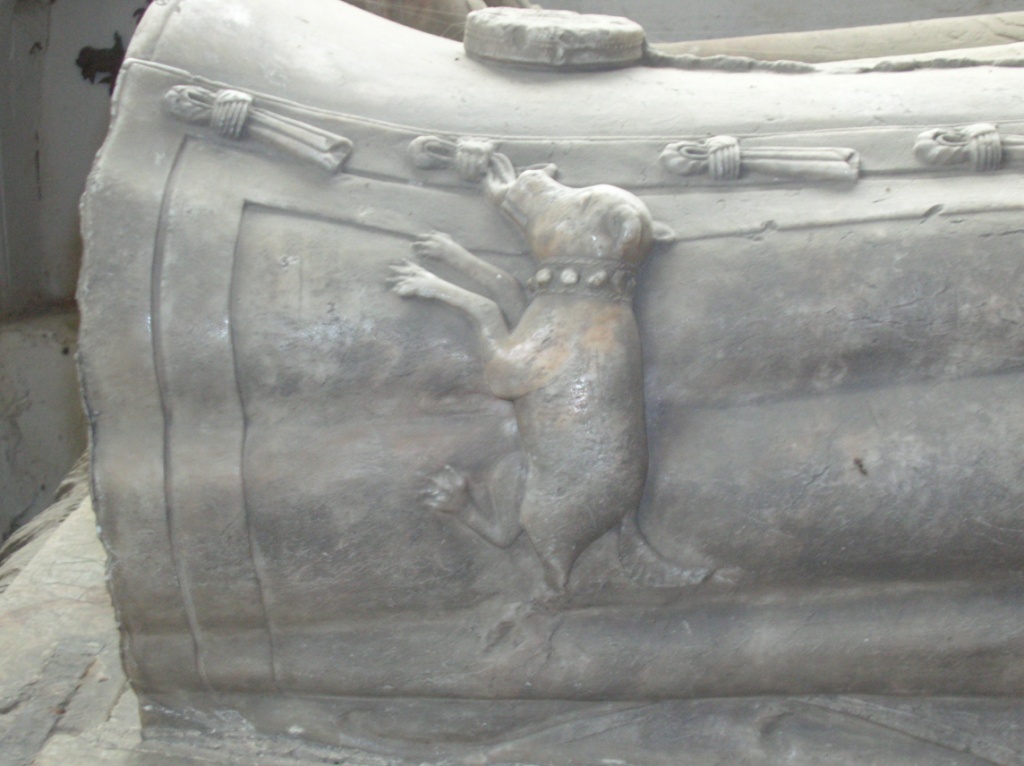
Even more interesting is the tomb of William’s heir Thomas Fermor and his wife Brigitta, on the south wall. Its full inscription reads: “to Thomas Fermor, Knight, a man of generosity towards scholars, mercy and goodness towards his people, admirable piety towards all men, the kindly lord of this estate, and the excellent founder of a school. In perpetual memory of himself and his beloved wife Brigitta, his executors, in accordance with his will, have with tears erected this monument. He died in the year of our Lord 1580, the 8th day of August.” The effigies are by Richard and Gabriel Roiley of Burton-on-Trent. The alabaster is not of the best quality and the style is consciously archaic, but the tomb is important partly because it is well documented. There is no suggestion in the original contract that the effigies were to be actual likenesses of Thomas and Brigitta — rather they were to represent their standing in society and the number of their offspring. There is a naive charm about the monument as a whole, particularly in the way the ill-proportioned weepers support enormous shields of arms. In a nice touch, Brigitta’s little dog with a studded collar is busying himself untying one of the knotted ribbons on her dress. The weepers below include a swaddled baby, presumably a child who died at birth.
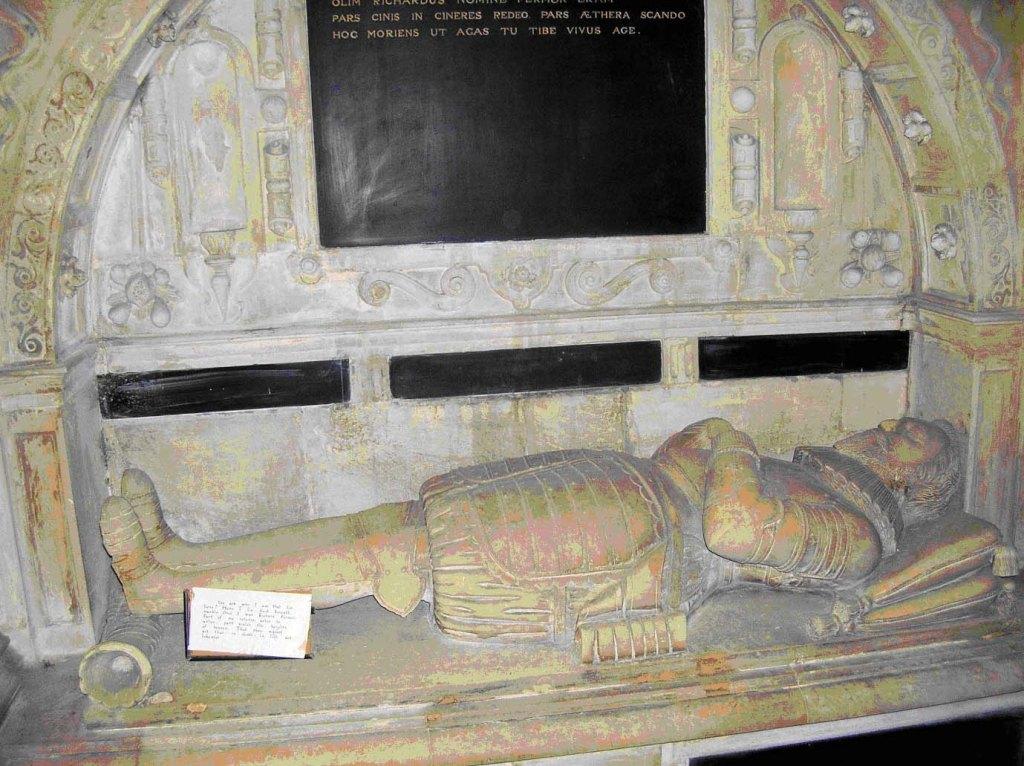
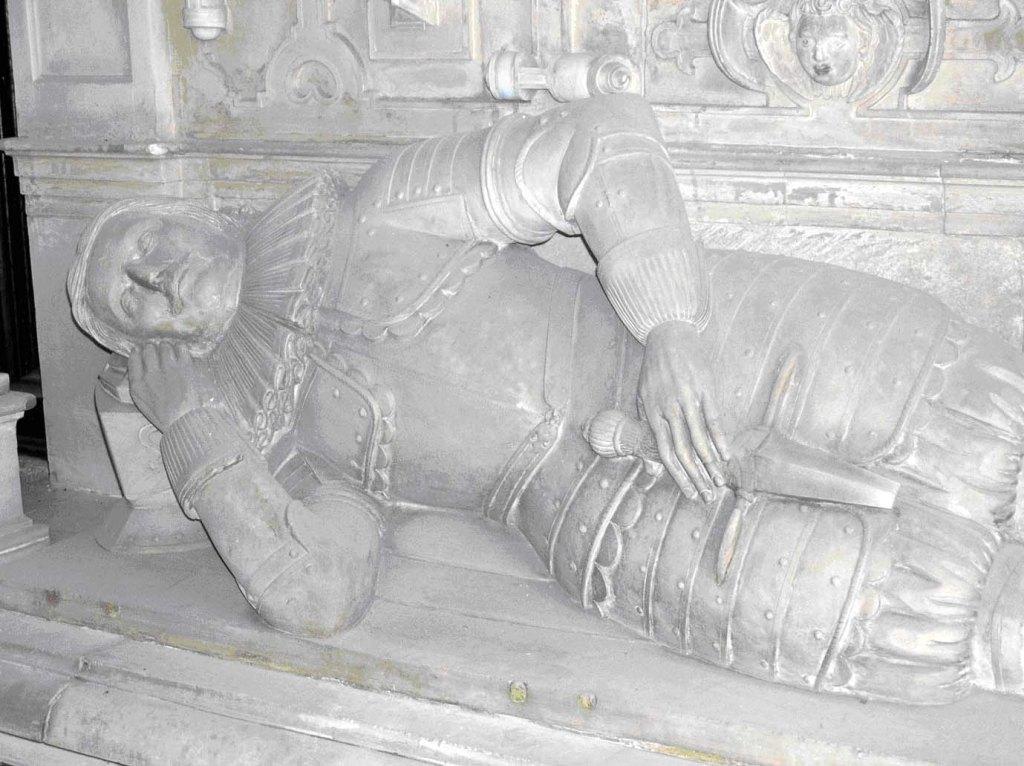
Next to Thomas along the south wall is the monument to Richard Fermor, his eldest son, who was lord of the manor until his death in 1642. It is in a very different style — the effigy lies under a Renaissance canopy, Richard on his back in what was by then a very old-fashioned posture. The monument is of painted limestone with black stone decorative inserts and columns; there should be a pair of obelisks at the top of the canopy. The whole monument would originally have been extremely colourful. It bears the inscription: “You ask who I am that lie here. Here I lie, dust beneath marble. Once I was Richard Fermor. Part of me returns, ashes to ashes, part scales the heights of heaven. That thou mayest act thus in death, in life act likewise.” The inscriptions to both Richard and John were probably re-carved in the nineteenth century: Trotter, who painted the monuments in 1801, recorded that they were virtually illegible but that he had found them recorded in an Oxford college. Richard’s young son Richard came of age in 1596 and in about 1625 moved his seat from Somerton to Tusmore Park, which he had bought with monies accumulated by his father’s executors during their trusteeship — Somerton, however, remained in the family’s ownership, and the manor house was still occupied by members of the family in 1665.
Opposite Richard on the north wall of the chapel lies John Fermor, his eldest son who predeceased him, dying in 1625. His monument bears a much fuller and sadder epitaph: "O hurrying traveller, grudge not to check thy step. See who I was and ponder well. My name was John Fermor, the eldest son of his parents and the first hope of the House of Fermor. I was in the flower of youth, my cheeks were bright and blooming, and having just married a wife I was full of joy. Scarcely had I begun my course when suddenly cruel Death bade me halt..."
On the floor of the chapel are ledger stones, among them one to Colonel Thomas Morgan, killed at the Battle of Newbury in 1643, who was husband of Jane Fermor. Parliamentary records refer to him as a "notorious papist and delinquent." On the west wall are three fine mural monuments by JG Lough (1789–1876), each in classical style with draped urns and grieving figures. One touching memorial shows Philippa Dewar (died 1853) being helped towards heaven by an angel as she clutches an infant, indicating that she died in childbirth.
On the floor of the chapel are ledger stones commemorating various members of the family, among them Colonel Thomas Morgan, killed at the Battle of Newbury in 1643. Parliamentary records declared him a “notorious papist and delinquent” and ordered his confiscated lands to be handed over to the trustees of the children of John Pym, the leading parliamentarian. As late as 1650 there were complaints to Parliament by Pym’s heirs that they still could not collect rents from the property, because the tenants were still paying rent to the Morgan family.
On the south wall of the chapel is an elaborate monument to James Smith and his wife Eliza. It is not entirely clear why this monument is in the Fermor Chapel, but Parliamentary records for Somerton also refer to one Thomas Smith as a noted recusant — if James was related to him, he may have been a close ally of the Fermors. It is also noteworthy that a small marble monument in the nave to William Mynn and his wife Mary commemorates another noted Catholic. Both monuments quietly extend the chapel’s role as a record of the village’s long recusant community.
On the west wall of the chapel are three monuments by JG Lough (1789–1876), the noted sculptor of funerary monuments. Each is in the form of a stele with a low pediment, based on the type of ancient Greek and Roman external standing memorial, with a relief sculpture on the face. Professor Brian Kemp comments that each is in its own way interesting. The monument to William Fermor (died 1828) depicts a lady grieving at a draped urn upon a column — probably his daughter, who erected the monument. The largest is to John Ramsay (died 1840), erected by his family and showing in a very moving way the members of the family, including children, in various attitudes of grief. The monument to Philippa Dewar (died 1853) shows an angel conducting aloft the soul of Philippa, who holds a baby — indicating, as the inscription “Thy will be done” confirms, that she died in childbirth. John Ramsay and Philippa Dewar were descendants of the Fermors, and it is notable that the family still wished to be commemorated in the chapel even after the estates were sold to the Earl of Jersey in 1815.
The screen separating the Fermor Chapel from the nave is probably fifteenth-century work — perhaps from an earlier chantry chapel — re-used when the Fermor Chapel was created in the sixteenth century from the east end of the previous south aisle. The screen separating the chapel from the chancel is Jacobean.
The Hatchments
The three hatchments from the Fermor Chapel — heraldic paintings displayed at the time of death — have recently been conserved by Sally Woodcock in Cambridge. The Frances Fermor hatchment bears the motto RESURGAM; others carry the Fermor arms in varying combinations. Their conservation formed part of a wider project that also included the restoration of the reredos and the Fermor monuments.
The Whall Window
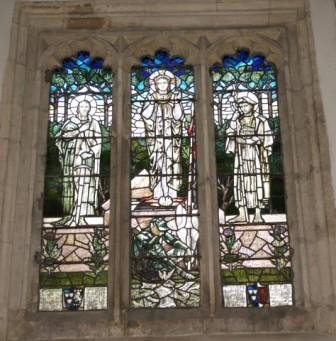
The William Barnes Memorial Window — depicting the Risen Christ with St James and St Paul — is an early work by Christopher Whitworth Whall (1849–1924), the leading designer and maker of stained glass in the Arts and Crafts Movement. It stands at the east end of the north aisle, notable for its simple but effective colour scheme of deep blues combined with silvery white and off-white tints of glass.
The figure of the sleeping soldier below the Risen Christ is shown wearing elaborate armour. Whall designed this suit and had it made in cardboard to be worn by the model who posed for the Archangel Michael figure. The window was made under Whall's direction by the London firm of James Powell & Sons, and was installed on 29th September 1893. The cost recorded in the Powell firm's archives as £46 — though the real cost to the Barnes family must have been substantially more.
Other windows of the church are of considerable interest. The stained glass shields in the north window are dated 1679 and bear the initials WF, with two exquisitely painted blackamoor heads which in heraldry indicated deeds of prowess in the Crusades. The clerestory windows and those in the chancel date from the same Victorian period and were designed by Henry Wilson.
— Jo Hawes — The Whall Window; Rosemary Arnold — The Work of Henry Wilson
The Nave and North Aisle
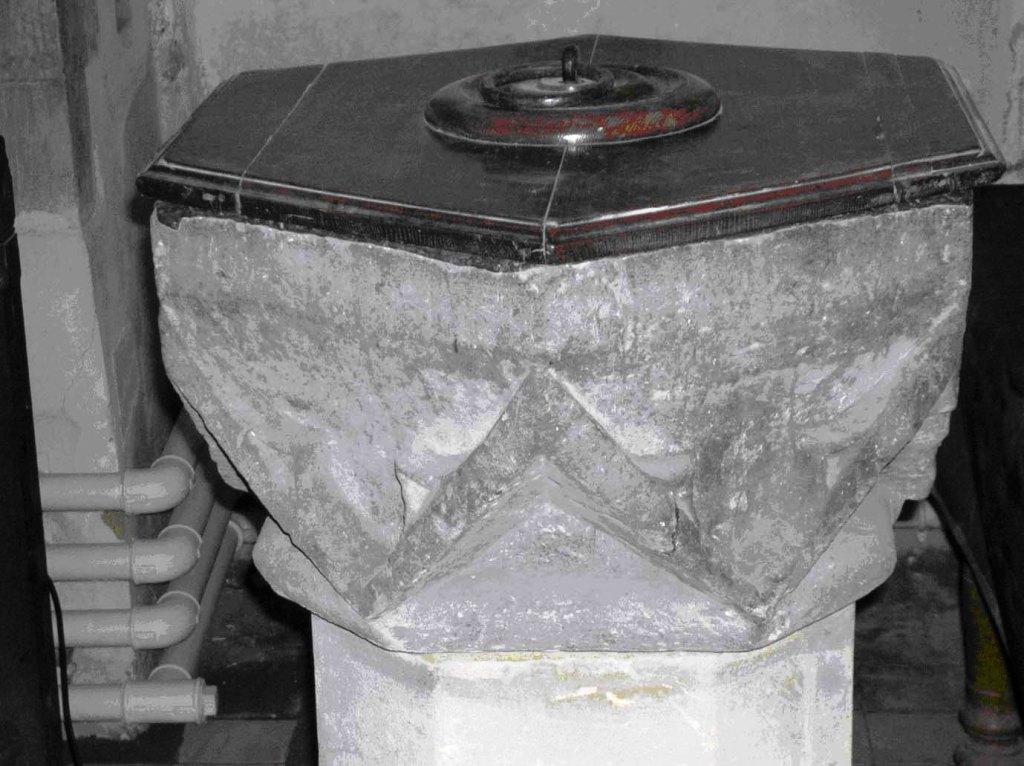
The font was moved to its present position in late 2009 but is medieval. Its unusual hexagonal shape suggests that it may not have been designed as a font at all. Sherwood, in the Pevsner guide to Oxfordshire, suggests that it may have been the base of a cross — an intriguing possibility given the site’s long history of pre-Norman worship.
In the south-west corner stands an ancient turret clock mechanism, probably dating to the seventeenth century and regulated by a system of weights and pulleys. The clock never had a face; it simply rang a tenor bell every hour. It is an easy thing to walk past without noticing, but it is a remarkable survival.
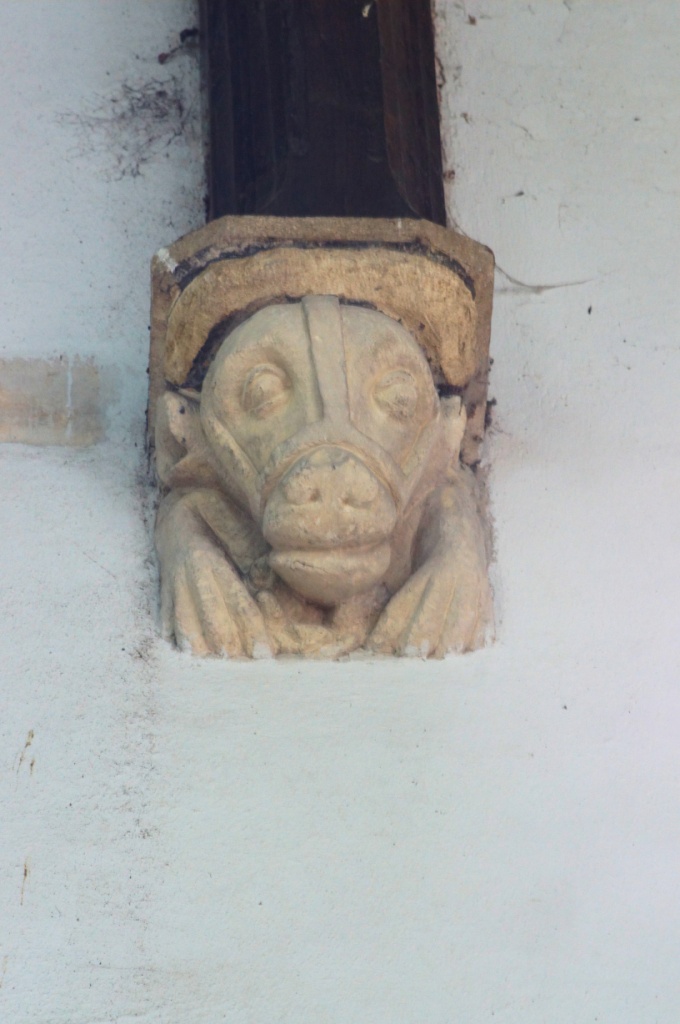
Some of the many pleasures in this church are quite hard to see. The carved stone corbels supporting the wall posts of the fifteenth-century ceiling are particularly good examples of the vigour and humour of the medieval tradition. See for example the head of the lion — or is it a bearded man? — on the second corbel from the east on the south side. Even harder to make out is the fantastic owl facing east, carved on the second tie-beam from the east. To the medieval mind an owl was a creature of darkness and ignorance, not the friendly and wise old bird of today — its presence here carried a very different charge.
— Basil Eastwood, with additional material supplied by Richard Wheeler, author of Oxfordshire’s Best Churches
The Church Bells
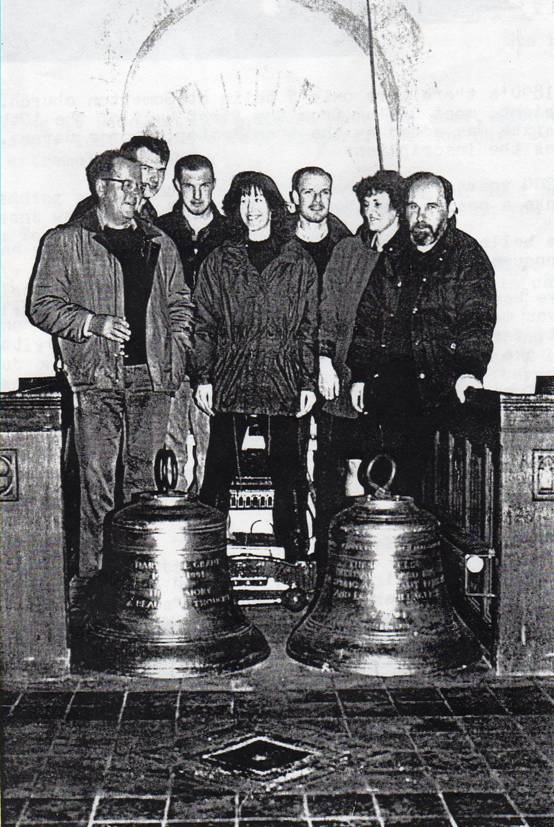
The ringing bells were installed in the tower in the seventeenth century. Originally there were four; two were added in the nineteenth century, followed by another two in the twentieth century — these last two donated by the Grant family, in remembrance of Shirley Grant's son Daryl Lee Grant. The original timber bell frame was replaced in the early twentieth century with a steel frame.
Up until the 1890s there were only five bells at Somerton, all of them ancient and mostly dating from the first half of the 17th century. In 1896 a sixth bell was cast by Messrs J. Taylor & Co, added by the then Rector George Barnes. All the bells were re-hung in 1931 into a steel frame, with provision made at the same time for two further bells. These two bells were cast at Whitechapel Bell Foundry in 1993, and were dedicated by the Venerable J. Hewitt Wilson in 1994, bringing the ring to eight.
Church bells were rung to announce a death. At Somerton this was done as soon as a death occurred — at one time round the clock, by the early twentieth century only between sunrise and sunset, as was customary elsewhere. Among the bellringers remembered from the twentieth century was Dick Gibbard, who lived at 1 Church Street and was known as a committed ringer before he moved away to High Wycombe in later life. He had worked in his latter years at the depot in Bicester, packing guns and ammunition. His name connects the bells of St James’s to the longer list of village families — Gibbard appears among the tenants in the 1919 sale particulars — who gave the church something of themselves over many generations.
— Shirley Grant and Neil Clare — St James's Church Bells
The Soldiers of Somerton
The memorial plaque in St James’s church records seven men from Somerton who gave their lives in the Great War: John Henry Allen, Frederick Hollis, Albert A G Lewis, Harry Stevens, William Watts, Henry James Watts, and F Harry Varney Wise. Individual research files were compiled for each man as part of the Somerton Village History Project, and are preserved in the church archive. What follows draws on that research.
John Henry Allen was born in Chesterton in 1896 and came to Somerton as a child, his family living in the Allotment Cottages where he and his father worked as farm labourers. He joined the 3rd Queen’s Own Oxfordshire Hussars in June 1915 and went to France that December. He came home sick the following spring, admitted to the Royal Hospital Chelsea with tuberculosis aggravated by his service, and was discharged in July 1916 as “no longer physically fit for war service.” He died on 18th December 1916, aged twenty. He was buried at Somerton five days later, and his burial is recorded in the registers of this church.
Frederick Hollis came from Ardley, born in 1890, the son of a shepherd. By 1911 the family had moved to Troy Field Barn, Somerton, where his father John and brothers Henry, Fred, George and Herbert all worked on the farm. Fred enlisted with the Oxon & Bucks Light Infantry and was serving in France by May 1915. He was subsequently transferred to the Middlesex Regiment. There are no surviving service records, but the Somerton parish register records him returning home as a “discharged soldier” aged 28, marrying Edith Maud Jarvis of Fritwell on 30th March 1918 — presumably discharged through wound or illness. He died on 22nd November 1918, aged twenty-nine, just eleven days after the Armistice. He is buried at Fewcott, and his name appears on the Ardley with Fewcott War Memorial as well as at Somerton.
Harry Thomas Stevens was born in Glympton in 1885, one of seven children. He moved to Somerton before the war, working as an ironstone labourer, and enlisted at Astrop, joining the 2nd Battalion Oxon and Bucks Light Infantry. He was killed in action on 26th September 1917, aged thirty-four. He is buried in Cambrin Military Cemetery near Béthune, just 800 metres from the front line.
William Watts was born in Fritwell in 1890, the son of George and Mary Watts — farm labourers who had moved the family to Somerton by 1911. By then William was already a soldier, serving as a private in the Oxon & Bucks Light Infantry. He was killed at the Battle of Loos on 25th September 1915, aged twenty-five, and is remembered on the Loos Memorial. His brother Henry James (Harry) Watts was born in 1893 and was still at home in Somerton in 1911, working as a plough boy. He served in France with the Oxon & Bucks before transfer to the 8th Battalion Machine Gun Corps. He died on 27th May 1918 during the great German offensive on the Aisne, aged twenty-five, and is remembered on the Soissons Memorial. Two brothers from one family; both lost within three years.
Francis Harry Varney Wise was born in Bloxham in 1895, but Somerton was his family’s home: his grandfather Joseph Nash was a carpenter and wheelwright of Church Street, and Francis spent much of his childhood in the village. He enlisted on 1st September 1914, was drafted to Dunkirk, and eventually commissioned into the Royal Flying Corps — a long journey that took him through the Royal Naval Volunteer Reserve and several reserve battalions. He was awarded the Mons Star. On 13th January 1918 he took off from Hendon in a DH9 bomber en route to Martlesham Heath. At about 200 feet the aircraft suddenly banked and fell, killing both him and his observer, 2nd Lieutenant Albert Payne. He was twenty-two years old. He is remembered on the memorials at Somerton, Wroxton and Teddington. His brother Arthur Sidney was killed later that same year on the first day of the Battle of St Quentin.
Albert A G Lewis is also named on the Somerton memorial plaque, though his individual research file has not been located among the Somerton Village History Project records held at the church. The research continues.
These were not strangers to the village. Their surnames — Hollis, Watts, Stevens, Allen — run through the 1919 sale particulars, the school records, the census returns. They were the sons of farm labourers and shepherds, plough boys and carters, men who had lived and worked in Somerton’s fields. The plaque mounted on the wall of St James’s to the left of the church door is the village’s permanent record that they existed and that they are not forgotten.
Windows on Time
The windows in St James’, like the church and the village, have a history which can be traced back over several hundred years. The most famous stained glass window — the Whall window — is described separately above. But the others are of considerable interest in their own right.
Repair and restoration of some of the windows was carried out in 2010. Some of the panels of glass had to be removed to allow the iron rods which support them to be replaced. When the panels were first erected, a niche had been cut into the stone on either side, one side deeper than the other. The panel was inserted by sliding it into the deeper cut, then slid back to fit into the shallower slot, with a peg inserted to keep the whole thing in place. Another, more recent method was by overlapping the panels — as in the south window, which was re-leaded in the eighteenth or nineteenth century, the work probably carried out by a plumber. Plumbers were used to working with lead and glaziers were scarce at that time, so it seemed the obvious solution.
Most of the ironwork in the windows is mediaeval. In the north aisle, the earliest rough-looking opaque panes date from the fifteenth and sixteenth centuries, fitted alongside seventeenth-century panes and some later glass — as panes were broken over the centuries they were simply replaced with the glass then in use, creating an accidental record of several hundred years of glazing practice.
The stained glass shields in the north window are dated 1679 and bear the initials WF — almost certainly William Fermor. They have two exquisitely painted blackamoor heads, which in heraldry indicated deeds of prowess in the Crusades. The nineteenth-century east window was thought by the restorer Jonathan Cooke to be possibly the work of John Hardman, a pupil and collaborator of Augustus Pugin, renowned for his church glass. The clerestory windows and those in the chancel were designed by Henry Wilson, who carried out much of the late Victorian restoration and was a close friend of Christopher Whall — it was Wilson who recommended Whall to design the Barnes memorial window.
— Rosemary Arnold. Acknowledgements to Peter Howell, former chairman of the Victorian Society, and Peter Cormack, Deputy Keeper, William Morris Gallery.
The Work of Henry Wilson
Restoration of St James’s church was proposed in 1889, the architect being John Sedding, who described the church as “of great interest” for “the singularity of its appearance, and its value as a specimen of an Old English church, unspoiled by modern interference.” The restoration was originally conceived before Sedding’s early death in 1891, and the cost was estimated to be £2,500.
After 1891 the interior refurbishment was largely undertaken by Henry Wilson. Wilson was born in 1864 in Liverpool and began his career as an architect. In 1888 he became the principal assistant of John Dando Sedding, whose close involvement in the applied arts was a profound influence. When Sedding died many of his projects were completed by Wilson, including that of St James’s. Alongside his architectural work in the 1890s Wilson also took up sculpture and metalwork, becoming one of the finest metalworkers of his time. His textbook Silverwork and Jewellery is still widely regarded as a classic craft treatise.
The marble and bronze William Barnes Memorial is an excellent example of his sculptural work. The motif of the roaring lions, carved on the capitals of the columns supporting the upper part of the monument, is especially characteristic. Wilson was also a gifted designer of woodwork and carving, and his love of animals and all aspects of nature is shown in the delightful carvings of the choir stalls, produced in collaboration with the firm of Charles Trask of Norton-sub-Hamdon, Somerset. These are among the finest examples of Arts and Crafts woodcarving of their type since the Middle Ages. Wilson also designed the decorative glazing in the chancel, where the patterned glazing with floral motifs in tints of greenish and silvery-white glass resembles the more extensive scheme at St Mary’s, Lynton, Devon.
In 1912 Henry Wilson and his family left England for Italy, although he often returned to supervise projects. In 1922 the family moved to France, where Wilson died at Menton in 1934. His contribution to St James’s — in stone, wood, glass, and metal — is one of the most complete surviving examples of the Arts and Crafts movement’s engagement with a parish church, and it gives the interior much of its distinctive character.
— Rosemary Arnold. Acknowledgements to Peter Howell, former chairman of the Victorian Society, and Peter Cormack, Deputy Keeper, William Morris Gallery.
A Visitor’s Account
Rarely have I enjoyed a church so much as the Church of St James, Somerton. The church stands on a rise of ground on the south side of Church Street, looking out over the Cherwell Valley. The path leads past a gnarled apple tree, which was bright with pinkish blossoms when I visited on a sunny spring day, then passes a medieval preaching cross on a stepped plinth.
What an amazing church. I simply didn’t want to leave. Everywhere I looked there seemed to be something fascinating. There were very useful signs, including translations of the Latin inscriptions on the Fermor tombs, but even so there were so many interesting features that I could only guess at the full extent of it. The reredos, the Fermor monuments, the rood screen, the choir stalls, the corbels, the hatchments — there really is a lot to enjoy in this wonderful historic building. The turret clock in the south-west corner that rang the hours without ever having a face. The hexagonal font that may once have been a cross base. The owl in the tie-beam. In a village that does not announce itself, the church holds more than enough for a full afternoon’s discovery.
— David Ross, Britain Express: The UK Travel and Heritage Guide